Anywhere Fest: Gumpoldskirchen

For our second Anywhere Festival Q&A, stellar playwright Bianca Butler gives us the low down on Gumpoldskirchen.

Q. Describe your show/s in under 25 words.
A. Estranged brothers take a rail journey across Europe to collect their father’s ashes. Catching up is funny, painful and more than a little claustrophobic.

Q. What makes your Anywhere venue the perfect fit?
A. Milton ‘Railway’ Park is situated between the Milton and Auchenflower train stations, and even has a kids’ playground in the shape of a steam engine, so the transit theme is strong. This ties in perfectly with Gumpoldskirchen, which is all about journeys, both literal and relational. The majority of the action takes place in train carriages and train stations, and throughout the whole play we see the transitory relationship of the protagonists, who struggle to find common ground. In their journey to become better brothers, they also move toward closure in their troubled relationship with their father. I’m indebted to the clever folks at Underground Productions for sourcing such a unique and thematically appropriate setting.

Gumpoldskirchen — Bianca Butler

Q. If you could stage your play anywhere in time and space (after Milton, of course), where would you choose?
A. It probably sounds boring, but I’m really happy with my play being performed here and now. If I could look a year or two into the future, I would love to see it transfer to main house production with one of Brisbane’s professional theatre companies, like La Boite. I think the play would work really well in the Roundhouse Theatre space. Longer term, I would love to take a touring production to all the towns and cities that feature in the play, starting with the tiny village of Clun, Shropshire, and finishing up in Gumpoldskirchen itself.

Q. Family secrets are exposed in Gumpoldskirchen. Do you have any ancestral skeletons in the closet you could tell us about?
A. That’s a tough question. The play I’m working on now is inspired by something that happened in my dad’s family when he was a boy, but there aren’t really any skeletons there. It’s about how his parents took in American soldiers on R&R leave from the Vietnam War. It’s not very scandalous, but I found the research process fascinating.


Q. Will Poirot be accompanying us on this potentially dangerous train journey?
A. Alas, not including Poirot was my folly! There are a couple of Belgian characters, but sadly they are neither detectives nor cultivators of a handsome moustache. Next time perhaps.

GUMPOLDSKIRCHEN runs at Milton ‘Railway’ Park, Corner Nerida Lane & Milton Road, from 8 to 12 May, 2013.

Anywhere Festival: MaXimal

Anywhere Festival is about to kick off in Brisbane! To celebrate the making of art all over Brisbane — outside, inside, on the airwaves, in the elevator, in the streets, in your pants — OffStreet Arts will feature super-rad Q&As with some of the festival’s most exciting acts. To begin with, I chatted with Scott Sneddon, aka Darkwing Dubs, about his show, MaXimal!

Q. Describe your show/s in under 25 words or fewer.
A. A very stupid idea: pooling together spoken word, hip-hop, songwriting and comedy into an hour of crazy. It’s awesome.

Q. Anywhere Festival is about making art … anywhere. What makes your venue unique?
A. I got a river view, at The Edge — right on Southbank next to the library. With boats n stuff going past. Plus The Edge is awesome and I’d do anything to support them!

MaXimal — Darkwing

Q. If your show were a new My Little Pony, what would it look like? What would its superpower be?
A. It would have a ninja outfit and jump out — like HOOYA — and you would say that it wasn’t a good ninja because you saw it coming but then you would start choking and the My Little Pony Ninja would be like, “Or am I the best ninja ever?” But you’d never get to answer the question cos you’d be dead.

Q. What is maximalist poetry?
A. Maximalism is everything you’re not meant to do in poetry — it’s not earnest, serious or clever. It’s basically a pisstake of the whole thing and heaps of fun and something that tends to make people cry with laughter. Therefore it is my favourite thing ever invented by me.

MaXimal! runs on the lawn, level 3, The Edge (SLQ) from 10 to 11 May, 2013, as part of Anywhere Festival.

Food: Item Not as Described

Trigger warning: discussion of sexual violence. (Also, relevant to that trigger warning: spoiler warning.)

La Boite describes Food as a “feast for the senses with an erotic mix of words and movement.” Critics call Steve Rodgers’ new play (directed by Rodgers and Kate Champion) sensual, a hilarious rom-com, soul food — “It will make you happy” (Stage Milk). Reading these reviews, I began to wonder if I’d seen a different play.

In Food, two sisters run a backwater takeaway joint inherited from their mother. Elma (Kate Box), the responsible elder sibling, is resigned to the daily heating up of Chiko Rolls until laidback Nancy (Emma Jackson) convinces her to transform the family shop into a restaurant. They hire charming Turkish traveller, Hakan (Fayssal Bazzi), to help out. From here, it’s well-trodden territory: the restaurant becomes a roaring success and Hakan spices up their lives as well as their cooking.

Anna Tregloan’s design is fantastic; the set features one central table against a backdrop of pots and pans. Clever projections transform these into glowing moons that frame home movies — the sisters’ childhood memories.

All action — highs and lows — takes place in this kitchen, and most of it whilst chopping vegetables. Needless to say, food is very important to Food. But it’s a stilted kind of food preparation, always pausing for conversation. I find myself wondering how the Chiko Rolls ever make it to the fryer. It makes me nervous. Handing out soup and wine to the audience is a nice touch, but being fed during shows is becoming more commonplace in the trend towards immersive theatre, and that puts the onus on each meal to do more. Mugs of minestrone abandoned after the show suggest that this scene is more of a distraction than a treat.

Box and Jackson

For Food, Rodgers collaborates with dance theatre company Force Majeure — something I was surprised to be reminded of after the show. The emphasis on movement is subtle or, at least, less rhythmic than it is frenetic.

Nothing lacks in the casting. Box, in particular, gives a genuine performance as the stoic Elma. It is uplifting to watch Elma realise her potential, and value, as a restaurateur. Jackson plays an intriguing Nancy, while Bazzi as Hakan makes an interesting transformation from happy-go-lucky pixie dream boy to entitled Casanova.

The trouble is that Food isn’t sure what kind of play it wants to be. It opens with Nancy dancing; increasingly, her movements become distressed, controlled — she is raped by an invisible presence. Cut scene, and we meet Elma and Nancy in the kitchen — where most of the play takes place. The sisters bypass the fourth wall now and then to narrate recollections in, variously, in the first and third person. Thus we flit back and forth between horrifying memoir (including several other instances of sexual assault) and cheery kitchen repartee.

When Hakan enters, pulling focus with a dramatic monologue and slideshow of his former lovers, the tone changes again — so much so that this scene is almost a play within the play. In some ways, this makes sense (he is the catalyst that’s meant to change the sisters’ world) but no transition is smooth. Likewise, while the women’s third-person monologues dissociate them from their pasts, they also promote Food’s overarching stylistic inconsistency.

It’s little wonder Elma and Nancy would want to distance themselves from the childhood memories they recount to us (in vivid detail), which include an instance of gang rape. But these sexual assaults, a source of tension between the older and younger sister, are never truly addressed — they serve to explain Nancy’s promiscuousness and sudden disappearance years before, and likewise to explain (in part, at least), Elma’s struggle with eating disorders. They’re scenes played to disturb the audience and garner sympathy, but these revelations don’t change the story or heal the characters.

The character of Hakan fulfils the cliché of the exotic traveller, just passing through, bringing with him a ray of sunshine. But this kitchen hand claims he can’t help but ogle a beautiful woman. (Elma points out he looks at Nancy “like she’s a steak.”) In the workplace, he sneaks up behind Nancy to embrace her. One failed seduction later, and he sets about taming the shrew instead.

So where is the burning sense of the erotic in Food that everyone’s talking about? It can’t be the slow top-and-tailing of beans, nor the minestrone, nor the Chiko Rolls. It’s certainly not the gang rape of a teenager by her peers while her sister waits outside. So it must be the creeping Casanova, overwhelmed by passion, who just can’t help himself. Given the women’s backstory, that this predatory sexual entitlement goes unchecked is problematic — unnerving, rather than erotic.

Rodgers’ script is thoroughly Australian in its sense of humour, yes. Moments of wit and playfulness shine through family drama and heartbreaking disclosures. But is it actually a comedy? I’d wager it belongs firmly on the drama shelf, far away from foodie feel-goods and tragi-comic comedies. But ultimately, it’s a shallow drama — with no one but the restaurant really changed by the end. Uplifting? I’m confused.

As a final note, as you enter the Roundhouse there’s a sign warning that the play contains course language, adult themes and simulated sexual intercourse. That’s a very different matter from themes of sexual violence, mentioned nowhere on that sign or on the website blurb — but appearing repeatedly in the play. I know it’s not just me who takes these themes into account when choosing what to see. On their booking page, La Boite takes the time to advise that “not all audience members will receive food.” Yet a warning regarding explicit sexual violence is overlooked.

Rodgers relies on “women’s issues” like sexual violence, eating disorders and fraught mother-daughter relationships to introduce pathos to a play that never intends to develop its three leads, who perform admirably in the face of a shallow script.

“It’s really about wanting,” says Rodgers in an interview with the Sydney Morning Herald. “Wanting intimacy with people, wanting the love and sex that feeds you and that can complete you, settle you.” Food tries to explore the desire for intimacy in the face of sexual trauma, but to do so Rodgers and Champion needed to handle Nancy and Elma’s childhoods with the depth, subtlety and sensitivity they deserved. That way, their moments of joy would have been all the more uplifting for the contrast. Alas, I certainly found Food wanting.

Food runs at La Boite until 27 April 2013.

Thing[s]!

Voiceworks Magazine #92 — Thing is out now. It contains one of my favourite ever VW poems: “Matisse Blue Nude II” by Jake Dennis. And I have a poem in there too: “Graveyard Haibun”. I’ve been working on this one for some years now, and I’m delighted it has found a home. It was the very first Toowong Cemetery poem!

Here’s the Thing:

Inside Voiceworks #92 you’ll find stories about two little fishes, a father wrapped in wool and musings about flies. Poetry of silhouettes becoming blueprint, detectives contemplating marriage and graveyards (but like, good poetry about graveyards). Nonfiction exploring gender, mysterious red chillies and what it’s like to be a white guy who really wants to ‘get’ hip-hop. Visual art and comics that will melt your brain in a way you know you want it to.

It only costs 10 monies and you can buy it at Avid Reader (if you’re in Brisbane), order it online, or buy an e-copy for five bucks. Voiceworks supports young Australian writers and also the whole committee is smokin’ hot.

Today’s second piece of news is that my review of Paul Summers‘ latest collection, Unity, is up on the Queensland Poetry Festival Blog — just in time for his reading at Riverbend Books next week. These events are always something special, and I’m really sorry I can’t make this one — so make sure you get along for me.

If you’ve ever had the pleasure of hearing Summers perform, you’ll read these poems in his low, lyrical Northumbrian voice. His accent permeates the metre; form or not, each poem writes its own rules of rhythm. They chant, rather than sing. Thus Summers weaves a spell of the senses.

Riverbend Poetry Series II is at 6pm, 23 April 2013. Tickets cost $10.

It Never Rains — It Purrs


1.

the sky conjures
luminous catastrophe
never delivers

poinciana lit up
like a cabaret stage

the spitting rain comes and goes
doesn’t even bother the cat

raindrops waver in clouds
lips inches from first kiss

2.

The storm plays with us,
rain falling and falling back
into the safety of clouds.

Wind bats at windows
we forgot to close. Hung-up
washing tries to flee.

Lightning eyes glint
and narrow, and unhurried
thunder purrs after, grey clouds

all puffed up, just watching
with one eye half-open,
not stirring, not yet.

The Birdmann in The Events of Momentous Timing

“The queen of Highgate Hill,” Tigerlil opens for the Birdmann with The Unrehearsal, a show that revels in the art of practised incompetence. Tiger Lil falls, spins, tangles and trips with perfect comic timing through a series of routines: whip-cracking, hooping, and puppetry. Tigerlil is always a pleasure to watch; however, each segment of The Unrehearsal feels overlong — if only by a little. From hooping to hoop skirts, she brings us to her stunning finale: a dextrous, devilish puppet climbs the skeleton of her undergarment to the boneyard tune of Waits and Burroughs’ “‘T’ain’t No Sin”.

We refresh our wine glasses and it’s time for the Birdmann’s Events of Momentous Timing. Billed as a one-man mystery, we join the Birdmann — in tails, tie, and tight black pants, with a plastic bag sticking out of one pocket — as he awakens from unconsciousness. Just how did our hero find himself handcuffed to an ironing board, holding one gorgeous black stiletto?

The Birdmann

The show follows a loose narrative through several events that help the Birdmann recreate that fateful night of the blackout. His mannerisms — simultaneously awkward and suave, and indeed birdlike — are the key to his comedy. The Birdmann shifts between cabaret-style one-liners (in the Aussie-noir tradition of Paul McDermott, Flacco and friends) and comedic circus feats. He defines this stylistic divide by dragging his plinth — the ironing board — to and from stage right.

It’s hard to take your eyes off the Birdmann. There isn’t exactly one word to describe him — and even the ones I’ve had to settle for don’t quite suffice. He has an eerie command of the surreal, but combined with that, an endearing — almost heartrending — dorky lonesomeness. As an example, this singular artist manages to have us screeching with laughter as he serenades and face-mashes a cupcake — his favourite comfort food and dietary supplement — but he tugs at our heartstrings too.

I won’t spoil the show for those yet to see it. The Birdmann’s mysteries are better unravelled in person. But he brings together a tenuous narrative with surprising cohesion and concludes with what can only be described as a stage spectacular worthy of Cher.

The Events of Momentous Timing, supported by Tigerlil, ran at the Judith Wright Centre from 23 to 24 March 2013.

Legally Blonde: The Musical

You won’t hear me say this often — but Oh. My. God, you guys! Legally Blonde, the stage musical adaptation of the film of the same name, is as bouncy, bright and shiny as Elle’s blonde locks. In case you missed the 2001 film, Legally Blonde follows Elle Woods — a ditzy, rich Malibu girl in search of a husband — along her journey to discover her own intelligence, drive, and inner beauty.

It may be that we’re coming to expect musical extravagance from anything John Frost (no relation, as far as I know) has a hand in producing. But Legally Blonde goes above and beyond. Its staging, choreography (Jerry Mitchell) and design (David Rockwell) are pretty close to flawless, from Elle’s towering Barbie-pink Delta Nu sorority house onwards. This is as glossy as musical theatre gets.

Mitchell’s choreography, in particular, has a way of drawing the eye towards detail — in costume, body language, or lyric — without losing sight of the bigger picture. Musically, Legally Blonde’s score (Laurence O’Keefe and Nell Benjamin) is no classic. The opening number, “Omigod You Guys”, is an instant earworm and “Chip on My Shoulder” is a resonant study-anthem, but beyond that the songs only really serve to carry us along through the plot. That’s not to say there aren’t lots of laughs — there are. The dialogue (Heather Hach) is sharp and sassy, if not terribly self-aware.

Lucy Durack (WICKED’s Glinda the Good Witch) is an exceptionally strong singer. She plays an endearing Elle more reminiscent of Clueless’s Cher (Alicia Silverstone) than Reese Witherspoon. Along with her shrill-voiced “Greek Chorus” of Deltu Nu sorority girls, her energy and optimism is infectious. When Elle arrives dressed as a Playboy bunny to a stuffy academic do, her confidence in the face of humiliation deserves the cheer it gets.

Rob Mills rose to fame on Australian Idol, and he’s in his element as the smooth, douchey Warner. David Harris channels dorky-but-charming Joss Whedon leads for his Emmett, the TA who encourages Elle to prove Harvard — and Warner — wrong. Helen Dallimore is a real standout as Paulette, a down-on-her-luck manicurist. But let’s not forget little Bruiser — Elle’s Chihuahua pup — who incites choruses of “aww!” from the audience (and never misses a cue or poops on anything!).

Legally Blonde: The Musical

Despite all this, Legally Blonde: The Musical is sparkly, shiny, feminist fool’s gold. (Oh come on, you knew this was coming from me.) Run the Bechdel Test past the play and you come up with one scene in which two women talk about something other than men — despite the major theme of Women Discovering Their Worth Through Study.

[SPOILER WARNING: highlight to read the next paragraph]

From here, it’s easy to follow the progression: Elle enrols at Harvard to pursue Warner; she gets into Harvard not because she passes her LSAT (she does) but because Admissions likes her headshot; she threatens to give up because Warner and friends belittle her; she gets back on the horse after a pep ballad from Emmett; Elle helps Paulette face down her ex — but Emmett supervises; and she gives up again because her professor sexually harasses her. Then, at last, we have the Bechdel-passing scene — followed by Emmett-supervised success and an engagement. (Elle’s endgame proposal feels something like a concession — as if that’s the fight for equality done with.)

[END SPOILER WARNING]

Some might accuse me of nit-picking. Sure, any of those instances in isolation are fine, and there’s nothing wrong with a male mentor. But, viewed overall, Legally Blonde’s final message isn’t “girls can do anything!” It’s really: “girls can do anything — with guidance from a man!”

There are other problematic elements. The scene that gets the biggest laugh is when Elle’s lesbian classmate responds enthusiastically to the “bend and snap”, Elle’s signature attention-grabbing move. It’s a joke that relies on the idea that lesbian desire is inherently funny. I could go on.

We should also mention, while we’re on serious matters, the totally unfortunate-looking shiny potato sack of a suit Elle pours Emmett into as she makes him over. Elle, I thought you had a Bachelor in Fashion Design!

In short: Legally Blonde is exceptionally well staged, wonderfully performed, and fabulous fun. Mad props! Go see it — and enjoy it. But take your critical eyes with you. Elle Woods wouldn’t expect anything less.

Legally Blonde runs at the Lyric Theatre, QPAC, until 21 April 2013.

P.S. Apologies for the late review! I saw Legally Blonde on opening night, 15 March, and then lost my review notebook. But here we are!

Escape from the Breakup Forest

Escape from the Breakup Forest (directed by Claire Christian and Ari Palani) is the Brisbane debut for Toowoomba’s Mixtape Theatre Collective, who formed in 2011. The show’s cut-out-and-colour-in forest set pieces take root in the Judith Wright Centre’s Shopfront.

The Shopfront is a good space for Mixtape’s intimate offering. The border between stage and audience is just a line of masking tape. We share the casual cabaret seating with a fellow critic, whom I hadn’t seen years, and a traveller who bought a ticket on a whim.

Steve Pirie, as Josh, takes the lead in a plot as simple as “boy loves girl; girl leaves boy; boy meets puppet.” The collective take their time telling the story of Josh’s romantic youth and eventual delirious five-year spin with Emma (Ell Sachs) — which ends in three years of red wine, Special K, and Friends re-runs. The real action starts when our mopey protagonist wakes up in a mystical land, the Breakup Forest, and meets Curly (puppeteering by Dan Stewart).

Escape from the Breakup Forest is one part Boy Girl Wall, one part Scott Pilgrim, and one part fresh-but-relatable comedy. In the mystical Breakup Forest, Josh must battle the memories of his exes and others who’ve hurt him. The narrative style (even some sound effects) seems heavily influenced by the work of Brisbane’s Escapists. Regardless, this production — along with the collective’s proactive attitude to making and funding theatre — suggests there’s more to come from Mixtape. And I’ll be watching.

Escape from the Breakup Forest

Pirie is one multitalented chap: he wrote and designed Breakup Forest, as well as performing the central role. Suitably pitiable as Josh, he embodies the role with just the right amount of charisma. Despite lingering on Chapter One, the scriptwriting is sharp. The cast has our motley table of viewers laughing together — and frequently.

The monochromic set design, along with projected animations, brings to mind “Elmo’s World” or, for a more grown-up audience, Don Hertzfeldt’s “Rejected”. Coloured lighting works really well in this regard, but could be harnessed more often. The cast, wearing white tees with details gaff-taped on, use cardboard props as costumes and weapons as they flit between roles. Sachs proves herself to be a versatile actor as she plays a series of Josh’s challengers: the female friend who dotes on him, the “slut” who rejected him in grade nine (a problematic character), and (signal boss fight) the memory of his ex-girlfriend Emma.

Unfortunately Curly’s simplistic design is limiting. Despite Stewart’s best efforts, Curly lacks the individual spirit we’ve come to expect from Muppet-like hand puppets — a pity, as he proves to be a major player in Josh’s story. But perhaps Escape from the Breakup Forest’s fatal flaw is optimism; in the end, the play takes a saccharine and all-too-easy escape route. While it might be a common fantasy, few dumpees as dedicated to red wine and re-runs as Josh can tap together their ruby slippers and vamoose; this particular wood is dark and deep, and there are usually miles yet to tread — on foot.

The Mixtape Collective’s Escape from the Breakup Forest plays at the Judith Wright Centre until 23 March 2013.

Au revoir, Kendra

In 2000, I was 11. We’d just moved back to Brisbane from Cambridge, UK, and I had failed to get my Hogwarts letter. I can’t say Year 6 was great. It was my fifth primary school across three countries. I was a busty nerd with an English accent; I spent a lot of time in the library. I did have a couple of friends. One, whom I doted on, gave me two things to remember her by: a pair of old black sneakers (which I wore, worn and repainted and worn again, until Mum binned them) and a kitten.

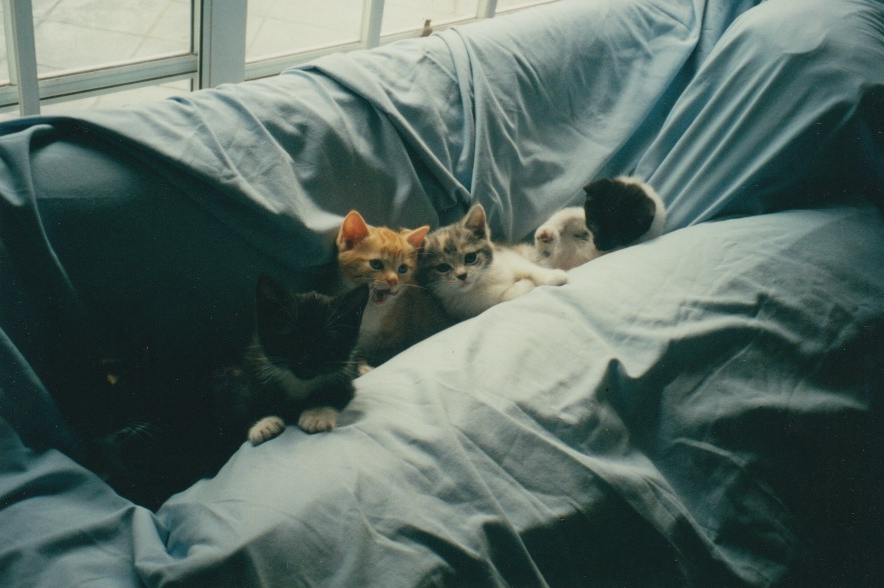
Kendra and siblings — she is in shadow, second left, looking straight at the camera.

Late in 2000 that friend’s moggy found herself in the family way. These are the little dudes that emerged: four boys (I think), and two girls. Mum let me choose one. I met them when they were three weeks old, eyes barely opened. There was a little grey girl with apricot patches and a tinier tortoiseshell. I’m a pretty indecisive person. I deliberated at length. I tried to talk my parents into letting me have both — it seemed cruel, anyway, to separate them. In the end, though, I think I pitied the tortoiseshell runt. I named her after the short-lived slayer-with-the-dreadful-accent who fought alongside Buffy in season two: Kendra.

Kendra on the stairsKendra was a difficult kitten. She drove my mother mad by shitting exclusively behind the TV, all over the cords. She climbed the blinds. She licked powerpoints. It seemed she had the deathwish of her namesake. But she had an enormous head on an impossibly-tiny body (see Exhibit B, above); she won us over pretty quickly.

Kendra had a taste for adventure early in life, but time made her a homebody. We had to chickenwire the fences in her first year to prevent her running out onto the busy road in Hamilton. I remember her darting up the jacaranda out the front, only to come face to face with a pair of crows, who just laughed at her. I had to pry her claws off the bark; she had just frozen there.

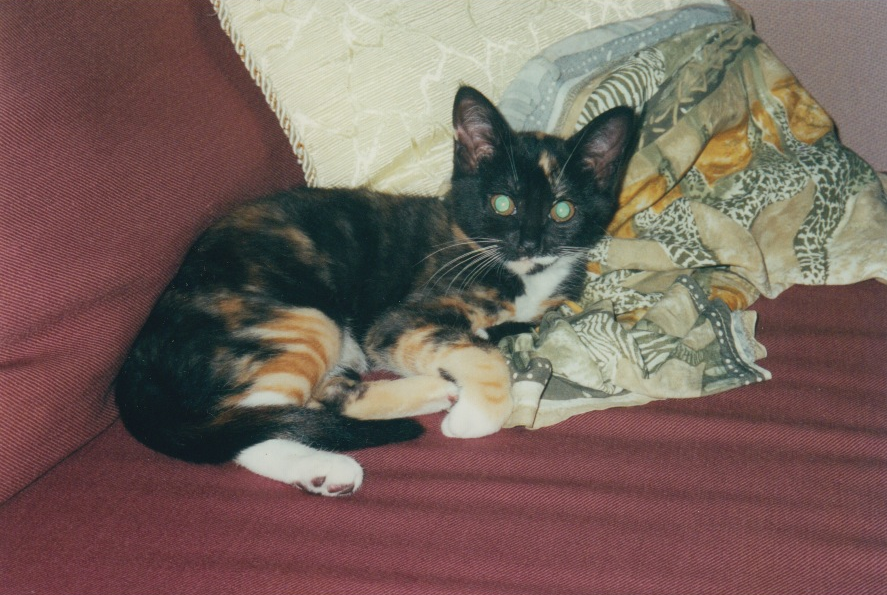
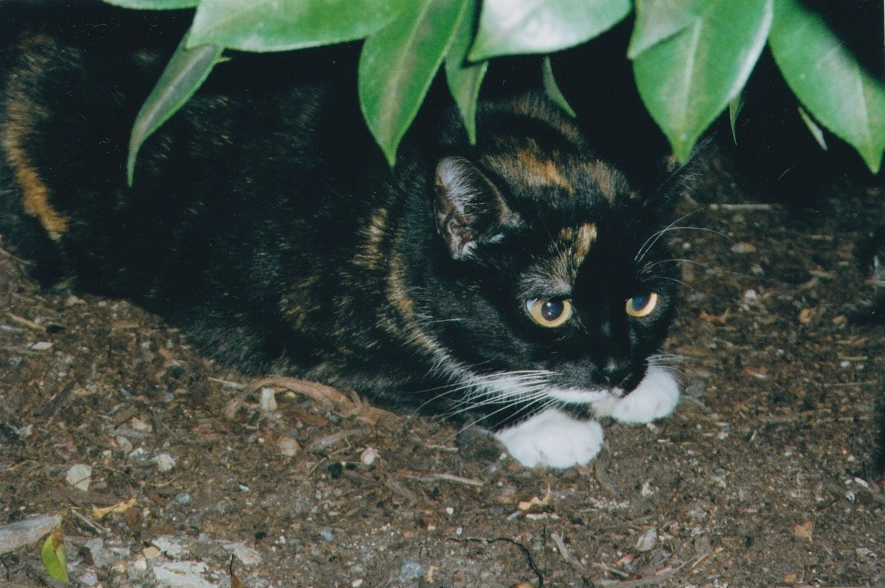
Kendra as a teenWhen I was 13 and Kendra was two — the first year of high school — we moved into a house my parents designed and built in the true suburbs. (It features a park built on the grounds of a demolished abattoir/tannery. Lovely!) My parents have a wonderful and beloved native garden. Kendra’s favourite spots were under the frangipani, on a warm paver hidden in the palms out the front, and close — but not too close — to the pool. Inside, she preferred the diamond-shaped motif at the centre of the foyer tiles, her old pink chair, and wherever Mum is.

Kendra 05

Around 2008, Kendra struck up a rare friendship with a very handsome Cornish rex from across the road. (He was intelligent enough to answer my question — “Where do you come from?!” — and lead me to his front door.) His name was Romeo. (I’m serious. It suited him, too.) He was charming enough that my parents didn’t mind him dropping by, strolling right into the house, to hang out. (It’s unfortunate I can’t find his photos — he looked like Hipster Simba.) He was an adventurous tom; it wasn’t long before we heard he’d met a car on the adjoining road.

I remember taking a couple of photos of Romeo with Kendra around to his family. Grandma and about four young children answered the door; Grandma eyed shaved-headed me with suspicion and gave me a talking down for mentioning that the cat had died in front of the children. “He has gone on holiday.” She handed the photos to the youngest of the children, who wandered outside and dropped them in a puddle. They shut the door in my face.

The remainder of the neighbourhood’s tomcats were less friendly. Kendra stopped going outside, except for essential garden visits, a while after that.

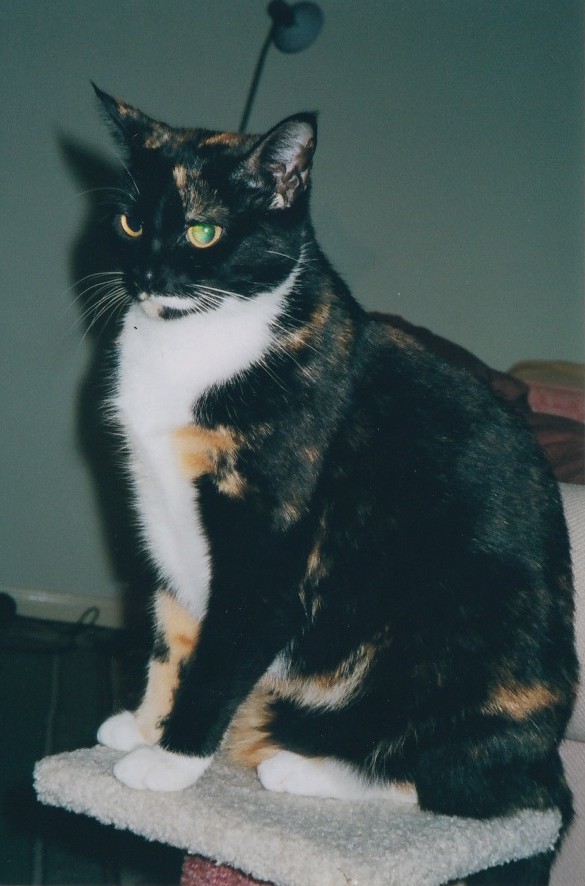
Kendra 03Kendra seemed determined to get past her runty beginnings. No matter how strict the diet, Kendra continued in her quest to become the roly-poliest of cats. Belly-rubs were pretty much currency in the Kendra Frost household. I wish I could find the photo of her sitting at the set dining table, evidently awaiting dinner with the rest of us [edit: found it!]. Her favourite foods were: anything. She even ate vegetables on occasion.

Kendra was extremely affectionate. She was the apple of Dad’s eye and seemed to have a knack for knowing when Mum was unwell. Given her bad knees and kidney and stomach troubles, she was a good contender for best tempered in a family of chronic pains. (Though we did have to whip out the Kitty Valium to get her into the bath.) She won over (most of) my partners as the years wore on. She was pretty good at giving (or denying) the tick of approval. If she liked you, she’d snuggle in behind your knees when you slept.

Kendra ready for dinner

I saw her three days before she died, and she was very happy to see me. I scooped her up and carted her around the house for a longer-than-usual while. She had a sort of pleasant vastness. (She made a great pillow.) We had started to worry she might be running out of time — she’d been making a lot of trips to the vet — but it was an abstract idea. Who knows what “soon” means?

My parents found Kendra on the tiles close to their bedroom door. She died during the three hours they were at Cloud Atlas. Mum was bewildered — just that day she had washed all of the kitty blankets at once. They buried her with one of them — one of my baby blankets — in the patch of garden where I’d planted sporadically successful rosebushes years before. I’d had an overwhelmingly good day; my parents decided to wait until the next day to tell me. Kendra and I had been friends for 13 years. I guess I would’ve liked to have seen the body. But I appreciated my parents’ gesture, and it couldn’t be helped.

zf_ kendrawbouganvil

This weekend we planted daffodil bulbs over Kendra’s grave. I spend a fair amount of time in cemeteries, but I don’t typically know anyone in them. Even as an adult it’s hard to get your head around the idea that your friend is under the ground.

Now, I know you few readers are good folks who understand it’s only a token gesture to give a measly 1000 words to a cat you spent half your life-to-date with. (I once had a boss belittle me repeatedly for grieving the death of a pet rat.) But it’s funny — we humans, or most of us, spend our lives trying to do stuff that might make our lives memorable. Domesticated or not, animals don’t have that goal and most don’t get that chance. Kendra wasn’t the first cat in space and nothing about her was meme-able. She doesn’t have a tombstone. She wasn’t even registered with the council. But my parents’ house seems horribly empty now. And we love her a lot. So here we are.

Kendra Frost
1 Sept. 2000 – 11 Mar. 2013
Died at Brisbane

Dancing with Bach

Judith Wright Centre, March 6

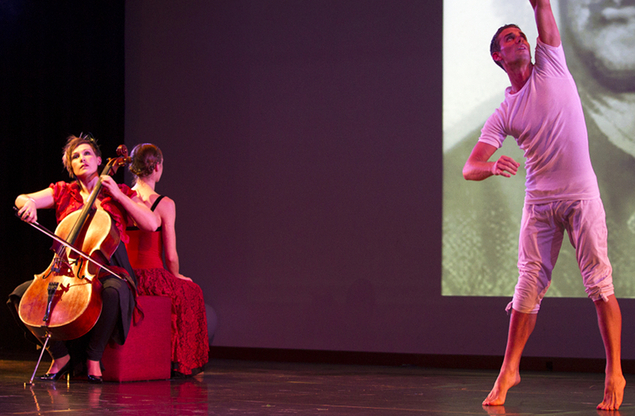
Bach’s Cello Suites were amongst the first suites of classical music to work their way into my bones. Lucid Dance Theatre’s Dancing with Bach project, choreographed by Louise Deleur in collaboration with cellist Louise King, aims to evoke the feeling of the suites as well as to paint a portrait of the composer’s life and work through dance.

But first, before Bach, we are shocked into a short piece called Surge — a lightning storm of a dance piece, performed by two sinewy figures upon a beach. The visuals are engrossing, with the dancers silhouetted against shoreline. We can almost smell the salt in the air.

There’s a 10-minute break that is determinedly not an interval: house lights go up, pop music hums, the stage is set for the main event — but we can’t leave our seats. At last, lights go down and bow meets cello. King’s performance is fluid and captivating. It’s easy to focus on her body language, but the dancers too are worthy of attention. They do more than dance to the music; the aim is to perform the suites with the body.

Dancing with Bach

Dancing with Bach is a work developed through the Judith Wright Centre’s Fresh Ground program. It’s an interesting production in this theatre space. With cello the only accompaniment, the thud of dancers’ feet on stage reverberates. In some ways, this focuses us on the dancers’ visceral movements; in other ways, it’s distracting. (You could hear a pin drop — or the sound-techs whisper.)

I always try to state my biases: dance is something I’m only learning about. For me, Dancing with Bach is an unsubtle piece — a little heavy-handed, heavy-footed. Rikki Mason dances the role of Bach himself, with Melissa Tattam and Elizabeth Barnard. Their danced relationships are intimate and tense, yet perhaps it is the sonic-emptiness of the space that makes communicating this intimacy to the audience difficult. Projections on a tall, thin screen illuminate stories from Bach’s life and, in this manner, we are unnecessarily told that we “find a world of emotions” in the suites — something the performance itself inherently seeks to show. The show don’t seem confident that the music will guide the dancers’ movements and our reactions and, as such, Dancing with Bach never seems to get the timing just right.


Dancing with Bach played at the Judith Wright Centre from March 6 to 8, 2013. 

For a different point of view, I liked this review at SameSame.com.au.