THEATRE REVIEW: 1984

Cremorne Theatre, QPAC
17 July 2014

Photos by Dylan Evans

In the intimate (even stuffy) Cremorne, we are blinded by roaming searchlights. A huge screen looks down upon us from the bleak stage. Shake & Stir immerse their audience in George Orwell’s 1984 — a draconian future where “war is peace, freedom is slavery, and ignorance is strength.” Here, the past is malleable and even private thought is public property.

Bryan Probets is compelling as Winston Smith, the quietly sharp, nervous dissident who works in the Ministry of Truth rewriting records of the past. The telescreen — a two-way television that both broadcasts and monitors — dominates his home and life. Winston’s internal struggle against Big Brother is broadcast to us even while, in person, he hides from prying cameras. His monologues induce doublethink in the audience: we know this is private; we know we are watching.

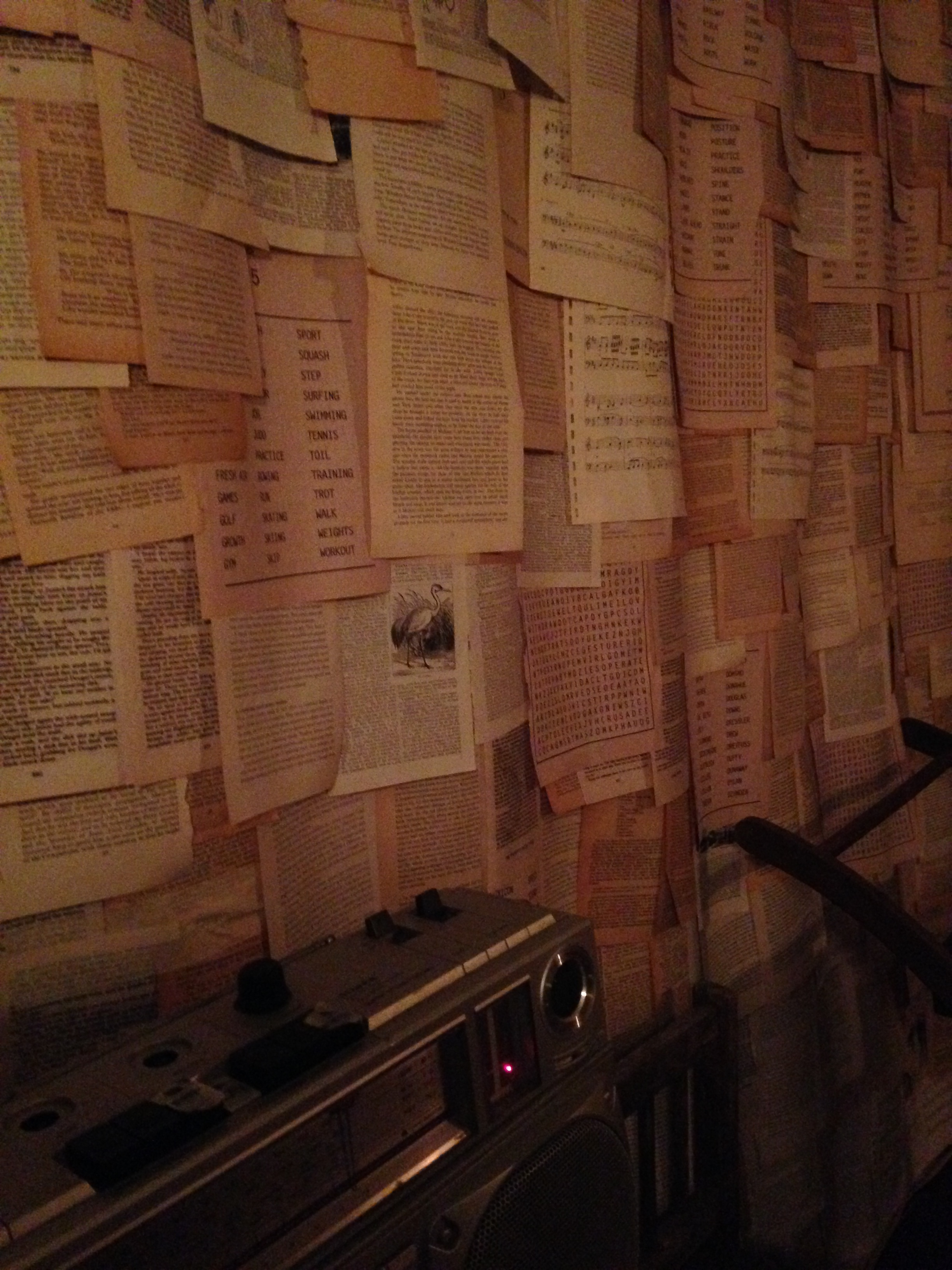
Set designer Josh McIntosh has stashed the past in crevices and under floorboards. The unfolding of a secret, museum-like room is a special delight. But it’s Optikal Bloc’s visuals that are at the heart of this production. (Ironically, they edited 2013’s season of Big Brother for Nine Network.) Matched with Guy Webster’s suitably overwhelming sound design and Jason Glenright’s always-clever lighting, Optikal Blok evokes a claustrophobic sense of constant surveillance.

1984 — photo by Dylan Evans

Unfortunately, the cast can’t quite maintain this sense of dread. Ross Balbuziente, Nelle Lee Julia and Nick Skubij — company co-artistic directors — each seem miscast as cartoonist iterations of their characters: keen patriot Parsons, secret rebel Julia and elderly antiques-peddler Charrington respectively. David Whitney as O’Brien brings a gravity essential to the double-agent role; he is the production’s much-needed metronome, keeping the pace even.

There’s a particular bleak resonance in Orwell’s vision: in 2014, we enact doublethink every day; we willingly cling to the devices that monitor and data-mine us. Michael Futcher makes note of these phenomena in his director’s notes. Yet scenes in 1984 that ought to remind the audience of its role in its own panopticon are often played lightly enough for laughs. Winston’s prison experience is at one point reduced to toilet humour. And, significantly, there’s a bitter-sweetness lacking from his frantic connection with Julia. Even the live rats meant to signify terror are, well, really cute.

Shake & Stir’s production faithfully follows the plot and text of Orwell’s 1948 novel (I did my homework and read it last week), yet something is missing. No amount of audio-visual saturation can stand in for genuinely felt fear. Opening night, if I understand correctly, was the 101st showing of this particular adaptation; after 124 days on the road, perhaps 1984 is going through the motions. Still, Orwell’s inventive language alone reminds of our tenuous grasp on memory; our disconnection from inconvenient histories; and how easily we might be complicit in our own enslavement.

“If you want a picture of the future,” says O’Brien, “imagine a boot stamping on a human face — for ever.” Shake & Stir has long since found its feet; during 1984’s QPAC run, I hope it’ll find its steel-capped boots.

1984 plays until 2 August 2014 at Cremorne Theatre, QPAC.

Poems and Possums

July is here; we’re at the halfway mark of 2014 already.

I had a great time last week reading new poems at Ruckus! Slam and a few of 2014 Arts Queensland poet-in-residence Warsan Shire‘s poems at Riverbend Books. And today Scum Mag has published one of the poems I debuted that night: “Blood Spells“.

Lots of projects will come to fruition in the year’s second half: Rachael Briggs and I will trouble you with two-voiced monster-poems at Queensland Poetry Festival; my friend Kit Loke will launch the poetry blog we’ve been working away at together; and Walleah Press will launch my book Salt and Bone.

Here’s a sneaky preview some of Bettina Marson‘s cover art for Salt and Bone, partly to celebrate the half-year and partly because I can’t wait to share Bettina’s amazing work:

by Bettina Marson

by Bettina Marson

Stay tuned for launch deets — coming soon!

Ruckus! (and a poem)

Ruckus! Slam, having left its beloved Hideaway, has found rad new digs at the New Globe Theatre. The Whitny Kapa Band and I feature — and there are 16 coveted open mic spots. See you there at 7pm, 25 June.

In the meantime, I’ve chucked a new recording up on soundcloud for your listening amusement: “Cimetière Des Innocents, 1786” (previously published in Ricochet Magazine). No, I have no idea if I’m pronouncing the French bit right. But the gory details therein are a true story. Human-fat soap. Good times.

Interview with Australian Writer Zenobia Frost

Blogger Geosi Gyasi interviewed me for his blog, Geosi Reads:

Geosi's avatarGeosi Reads

Credit: Raw Bones Credit: Raw Bones

Brief Biography: Zenobia Frost is an Australian writer and editor whose debut poetry collection, The Voyage, was released in 2009. Zenobia (Brisbane) is the assistant editor of Cordite Poetry Review. Her work has been published in Voiceworks, Overland, Southerly, The Lifted Brow and Rave Magazine. Zenobia was shortlisted in the 2013 Overland Judith Wright Poetry Prize and won second place in the 2013 John Marsden Prize for Young Australian Writers. Her debut collection, Salt and Bone, is forthcoming from Walleah Press.

Geosi Gyasi: Between Page and Stage, which one is your first love?

Zenobia Frost: Page, I think. Writing poetry was how I learned to be happy with my own company. I can fiddle with one line or one piece of punctuation for hours on end. Sometimes, when I write a new poem, I’m excited to wake up the next morning just to see it with fresh…

View original post 1,178 more words

Poem: “Varuna”


five days in
dark rooms begin
to lose their menace

alone or close enough
domestic ghosts
nowhere to be seen

but in the hum
of unfamiliar stillness

this country house
listens
more than speaks

takes notes
stretches out its tall spine

in my room
the ladder to widow’s walk
sighs in upward slumber

there is so much here
of you, Eleanor

this thoroughfare in veneration
of your work

the first book I choose
has your impression

I thought once that I saw you
by the fire

but we aren’t introduced
to one another

and in this quiet
I am looking for stories


In 2012, I spent a week working on my manuscript at Varuna (once the house of Australian author Eleanor Dark), courtesy of CAL.

The Poetry Object: Concrete Poems / Virtual Workshops

Last week marked my first South Australian poetry gig, thanks to The Red Room Company: I took a Skype trip to Adelaide to visit the Year 8s of Wilderness School, who are taking part in Red Room Poetry Object.

The Poetry Object is an annual competition open to school students in Years 3–10. Last year, Red Room asked me to contribute my own talismanic poem to the project — and the object I chose was my local Civic Video. In Red Room’s words: “‘Civic Duty‘ is a restrained detailing of the slow death of video rental stores: a period business that may one day be remembered with nostalgia, like milk-bars and roller-discos.”

Vale Civic Video Rosalie

Our Skype workshops were brief, with 20 minutes per class, so I framed them as conversations. What did the students already know? What did they want to discover? The young women of Wilderness School, it turns out, are pretty clued up when it comes to the mechanics of poetry, so together we unpacked ‘Civic Duty’ — its rhythms and devices — and discussed how they might approach their own poems.

There were plenty of blank faces when I explained my grief at the recent loss of Civic Video Rosalie. It’s enough to make a gal feel old. But it was otherwise wonderful to engage with these students, whose planned poetic talismans range from shells to farmsteads. Their knowledge and enthusiasm about poetry — and their wit — might surprise the bean-counters currently stripping Australian arts and education funding.

Photo by Ann Rooney (Wilderness School)

The workshop was organised by Ann Rooney, an English teacher at Wilderness School, who wanted the girls to learn that reading and writing poetry are skills that can be learned. I’m with Ann on this. Poetry has a mysticism, sure — as Prof. Dumbledore put it: “Words are, in my not-so-humble opinion, our most inexhaustible source of magic.” But viewing poetry as a craft gives writers control over their word-magic. To give students — especially young women — tools with which to hone their communication and art-making is to empower them.

For me, poetry is a process of fearless editing in the pursuit of what Sylvia Plath called “a closed fist” — poetry as a contained potential energy: a fistful of lightning. I hope I passed even a little of that idea on last Wednesday. And I look forward to reading their object-poems!

Only WA and NT to go before I’ve poeted in all states of Australia. Workin’ on it.

The Poetry Object is open to students in Years 3–10 in Australia and New Zealand. The Red Room Company has a wealth of poetry resources available online for teachers and students. Get in on it.

Salt & Bone: A Blog Hop

Ms Kaitlyn Plyley, poet and comedian extraordinaire (also generally a great gal and my true Harry Potter Scene It! adversary), invited me along to her bloggy sock-hop. This is a selfie-interview — a chance to reflect on (and, perhaps, pitch) a current project; then, I tag a few more bloggers and send the blog hop on its way.

  1. What are you working on at the moment?
    My big announcement for 2014 is that Walleah Press will soon turn my manuscript, Salt and Bone, into a living, breathing, spine-y paper thing. We’re hoping to launch the book around July. I’ve finally stopped fiddling with punctuation and order-of-poems. (Ralph at Walleah has been very patient with me.) Bettina Marson is working away at the cover design, which — in keeping with the books Brisbaniness — will feature possums, curlews, stilts and mud. (You can see Bettina’s designs for my 2009 chapbook in her ink portfolio.)
  2. How do you think your work differs from that of other writers in your genre?
    I like to think — I hope, at least — that I’ve developed a distinct poetic voice: a Brisbane voice, concise-but-not-sparse, flexible enough for both page and stage. That would be the answer as far as poetry as concerned. As regards nonfiction, I hope my writing is getting more precise and, if I’m lucky, funnier.
  3. Why do you write what you write?
    I write poetry because choosing the lowest-paying category of arts (and in this budget climate) just seemed like fun! Jokes aside, I find poetry compelling as a craft that’s impossible to perfect; each poem is an impossible puzzle. I can work on them infinitely, chipping away. It’s satisfying in an it’ll-never-be-satisfying sense. I also write poetry because a) I enjoy reading poetry and b) it’s short. Creative nonfiction gives me space to research and mull over and really get my teeth into a topic. It’s very different from writing poetry, and that’s good.
  4. What’s your writing process, and how does it work?
    I write a terrible first draft very quickly and then I spend millennia editing, fiddling, editing, proofing and putting-the-final-touches-on. This usually happens in the wee small hours, in bed with a good notebook.

Enough navel-gazing! Thank you for reading. Up next:

Michael Gerard Bauer: Michael is one of my favourite children’s/YA writers. His books are currently sold in over 20 countries including the USA and UK and translated into nine languages.

Sarah Gory: Sarah directs the Queensland Poetry Festival. Her blog, Highgate Hill Kitchen, started “as a way to document my cooking ventures, stay motivated to keep on trying new things in the kitchen, and share my daily stories.”

Eleanor JacksonEleanor is a performance poet who casts spells with her silky voice. Her most recent work, Now You See Me, was an interactive installation exploring the theme of queer visibility in visual art.

While we’re here, here’s a newish poem in Cordite’s No Theme III.

REVIEW: a library for the end of the world


sonder
, n. “the realisation that each random passerby is living a life as vivid and complex as your own” (The Dictionary of Obscure Sorrows)

Vena Cava presents an unusual work-in-development devised by Brisbane’s own Sarah Winter.

a library for the end of the world is a interactive work that challenges each solitary participant to explore memory and theory of mind. Through headphones, a guiding voice asks us some big questions — amongst them: if the world were ending today, what one memory would you leave behind?

Each half-hour session­­­ takes one traveller on something of a treasure hunt, guided by audio, to the library’s hidden location. The Anywhere Theatre Festival event page shrouds the library in mystery, but in doing so excludes important accessibility information: the production’s first half is a walking tour, with stairs.

This show embodies the spirit of ATF. Winter (disembodied) stages her performance outside of a traditional space — with the participant at the centre of the experience. West End is made strange and new through its frame as theatre. I am hypnotised: a great lover of audio books and spoken word, I follow Winter’s voice down the rabbit hole. It is simultaneously a meditative and thrilling experience to be led by someone unseen into unknown places.

a library for the end of the world

The library itself, once you find it, is an enchanting space. Its design hints at an outside-of-time otherworldliness — with the sensation that whoever works there may return at any moment. I can’t help but finger through curios and ephemera while listening to the library’s growing collection of memories. The analogue crackle of audiotapes is at once ghostly and fire-warm.

Throughout the show, I search through my own memories for the right one to leave behind. But when the time comes to hit record, my brain decides to tell another. That sudden memory seems as revealing as a tarot card. I leave the library pensive — even melancholy; I want more time alone within that experience to consider all the questions I’ve been asked.

A day on — at the time of writing — and the memory of the library has taken on the surreal, ephemeral glow of a dream.

Anywhere Theatre Festival runs from 7 to 17 May. Due to popular demand, a library for the end of the world’s season has been extended until 24 May.

Poem: “Graveyard Haibun”

(Previously published in Voiceworks #92 ‘THING’)

On Thursday morning I meet Death. We inherit Sydney’s red-dust storm, and our backyard is thick with it. The white cat with the poodle-cut is now auburn. She cleans herself uselessly, tongue moistening dust into clay.

Six am sun casts every gravestone reflective. I never get up this early. I settle on the hot, steady concrete of a grave, and try to learn silence.

Scarlet beetles skitter through dry leaves. Cicadas hum in hollows. Our raised necropolis is more awake than anywhere in this lidded city.

cemetery
spring’s new crows
let sleeping dead lie

I breathe and watch. For a rare moment, my mind too is warm, dark stone.

I go out to feed my flatmate’s old rat and find that his lungs are full of the desert. I sit on the kitchen floor with him in my lap. He is thin-blooded – an aspirin-thief in his youth. Now, his nose has stopped bleeding for the first time in months. Droplets congeal in the dust on his snout. I feel his body cease.

on the floor
we share rigor mortis

The cats sniff around us. They do not interfere.

I return alone, and enter the wilderness without pith helmet or field knife. Birds own the graveyard, swooping for me to turn back; the dead and I are just guests.

If I am very still, I fade into this place. My shadow thickens into my own ghost, leads me down paths that are only pretending. I wouldn’t mind being lost here. (I am already lost.)

hoop pines rise
from the jaws of skeletons
a final word

YOOF ARTS NEWS

I nearly called this YOOF ARTZ NYOOZ and I’m sorry. Maybe it should have been “They Have It Coming”. Anyway. It’s been a fortnight of arts-work by the young and the restless. This is definitely more of a discussion than a series of reviews. I especially welcome input from others who’ve seen or are involved in these shows.

BRISBANE (A DOING WORD)

Brisbane (a doing word)

Vena Cava has outgrown QUT’s Woodward Theatre; the student theatre company launches its new season in the Judith Wright Centre’s intimate Shopfront space. Here, we meet Matty (Patrick Hayes) and his share-housing frenemies, negotiating their place and purpose as 20-somethings in Brisbane. This coming-of-age story unfolds in pieces, benefiting from writer David Burton’s structural experimentation.

Burton’s characters are painfully relatable but never sterotypes. Claire Christian directs a strong cast; we’ve all lived or studied with these eager, energetic, argumentative people. We’ve probably been them. Overall, a little more polish and restraint will allow Brisbane (a doing word) to deftly handle the sensitive topics it tackles without losing its sense of absurd humour.

BRISBANE (A DOING WORD) ran at the Judith Wright Centre from 20 to 22 March 2014.

PERSPECTIVE/WOOLF PACK

Khalid Warsame at Brisbane's VOICEWORKS Launch

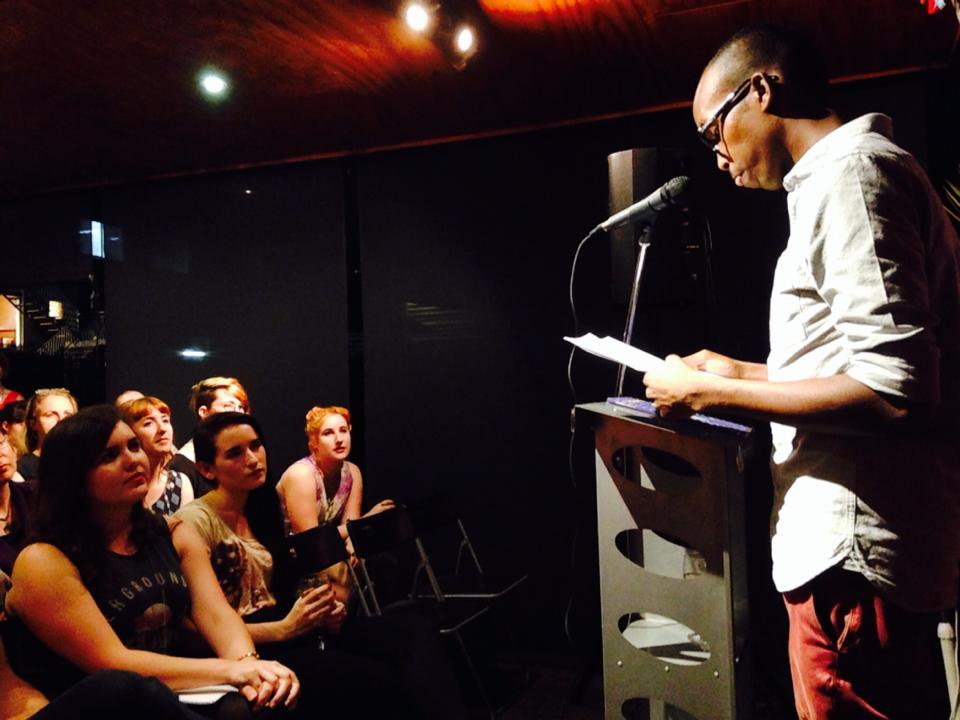
Express Media (or its Queensland representative … me) launched Voiceworks #96, the Perspective issue, at Avid Reader. Voiceworks Mag publishes and offers professional development of the work of Australian writers under 25. This was such a great night with superb readers (pictured: Khalid Warsame). Avid put on the ritz for us — what a wonderful venue. Wine all round! We also launched Woolf Pack, a new feminist zine edited by super-cool Brisbane ladies. Good times.

VOICEWORKS and WOOLF PACK launched at Avid Reader on 28 March 2014.

HOMOS IN KIMONOS

Homos in Kimonos

James Halloran and Will Hannagan’s double-bill cabaret (Melbourne Festival Comedy) has come under fire this week regarding its title, which some feel appropriates Japanese culture in a way that is racist. I’m hesitant to weigh in personally — as a white person I realise my privilege means I have blind spots — but I felt the creative team gave a measured, respectful public response in which they apologised and clarified their intentions. It was disappointing to see uncritical responses on both sides of the fence (personal attacks on the young performers and, on the flipside, tiresome attacks on “the PC brigade”).

I rarely feel qualified to comment, but I think there’s space right now in Australia for lots of context-based, critical discussion on cultural intersection in art. I hope that the show’s run stimulates more thoughtful, respectful discussion and fewer facebook shitstorms.

HOMOS IN KIMONOS runs at Melbourne Comedy Festival until 13 April 2014.

BOY&GIRL

Boy&Girl by Oscar Theatre Company

Oscar Theatre Company presents “a steamy cabaret of musical theatre, contemporary and pop where gender is bent and rules are broken” at Brisbane Powerhouse, after a season at Lightspace. Boy&Girl features 25 talented and diverse cast members with a Broadway/contemporary jazz vibe. Jason Glenwright’s moody lighting sets the right tone for a trip down the Weimar rabbit hole.

Now, I can’t call these thoughts a review, as I did not stay for the full show. For me, the highlight of the first half was a 40s wartime swing rendition of “Call Me Maybe” by three charismatic male performers, followed by an emotive solo covering Rizzo’s “That’s the Worst Thing I Could Do” from Grease. Overall, though, Boy&Girl only flirted with the idea of gender-bending: pronouns were swapped, sure, and the boys (but, curiously, not really the girls) dabbled in drag. The jokes were about as cheap as the lingerie. All up, a pretty conservative affair, with the cast unable to nail the sense of sexy-grotesque integral, in my opinion, to queered cabaret.

But none of this would be a fair reason to walk out. Generally, I think it’s pretty poor form to leave a show’s opening night midway. However, just before the interval, 10 men (plus the male host and four men in the onstage band) performed Chicago’s “Cell Block Tango”. This is a song that deliberately subverts language used against female victims of intimate and sexual violence; its power, humour and sense of the uncanny succeeds because, in the context of the song, women have what is normally masculine power. In Boy&Girl, “Cell Block Tango” becomes a deeply unsettling song about domestic violence. In Australia, where one woman a week is murdered by an intimate partner, loosely “gender-bending” the song puts the power back in the hands of those who already have it. I left because I couldn’t sit with an audience that found that funny.

BOY&GIRL runs at the Visy Theatre at Brisbane Powerhouse until 19 April 2014.