VW Flashback: Write of Passage

A few issues ago, I wrote an ed-comm-itorial for Voiceworks #93 “Cell”. Voiceworks publishes the work of writers under 25; in a couple of months, I’ll be forced to make my own way in the big world, elderly and alone. Not really — but I have had my last ever things published by VW. Gonna miss ’em. Stumbled across my recentish editorial today, so here’s a flashback. Sorry-not-sorry about the title pun.


Write of Passage 

In writing, as in life, the first cut is the deepest. Baby, I know. My first time was online. On a poetry critique forum. Some punk who didn’t even understand my poem thought they could tell me, the author, how to improve it. Hot damn! That first dose of red ink can sting.

I was sixteen and top of English. I was used to my poetry taking pride of place on my parents’ fridge. Yet someone out there thought my writing could be better. Much better. I’d like to say that was the day I left the comfort of LiveJournal and became a Writer-with-a-capital-W, but in reality I was too busy making my school-friends troll this anonymous butcher who had applied his untrained scalpel to my perfect poem.

First Critique can be a significant and habit-shaping event; it can separate the diarists from the crafters. It’s an experience many of us share—perhaps even an essential writers’ rite: to undergo the painful epiphany that accompanies extreme butthurt in the face of criticism. It didn’t sink in that exact day, but it was a step towards realising that first-drafting is only a small part of writing.

That poem was titled ‘Narcissism and Existential Lust Backstage at the Con’. Seriously. I wrote it while skulking around with my trumpet in the eerie blue lights backstage at the Brisbane Conservatorium, waiting for school band dress rehearsals. Dressed in yellow crepe, I mostly gawked at a hot sound guy who looked enough like an Anne Rice vampire for me.

So I wrote a poem for our sound tech Armand, employing ultra-subtle addiction metaphors because, at sixteen, I was pretty worldly (read: drank Absinthe once):

I can’t shoot up sense
I can’t see my veins
I’m floating in opium blue
there’s no substance abuse
there is only you.

I think I may even have tried to hand-deliver a copy. Bad habits start early.

That First Critique, perhaps, sets writers apart from musicians and sports players. While other kids take piano lessons and go to soccer training, few young-’uns are sent to poetry class or writing lessons. (Start more Dead Poets Societies in schools!) In ice-skating class, the first thing you learn is how to safely fall down—but most young poets, untutored, forge their own ways in cossetted, private notebooks.

Looking back, that critic’s advice was firm, but kind—and asked me questions, rather than directed me or rewrote my work. I had to realise I’d willingly entered a workshop forum where the aim was not so much to showcase as to practise. And one of the best ways to get better as a writer is inform your editing with readers’ feedback.

Of course, the critiqued poem doesn’t exist in a vacuum and neither does the poet’s response. I empathise with each new writer struck with the revelation that Plath and Neruda didn’t just pop those poems out fully formed. The nature of First Crit can bubble-wrap, buoy up, encourage or scar a new writer.

If you, dear reader, are one whose formative First Crit is far in the past, I urge you to think back on that experience and be considerate. But the real trouble is something much more insidious: beyond the boldfaced anonymity of online critique groups, serious peer feedback can be hard to find. Be considerate, but do still be critical. The only feedback worse than ‘You suck’ is ‘Don’t change a thing!’

The poems and stories you’re about to read in this issue have all been edited in collaboration with their authors. Works that didn’t make it in this round will receive feedback, too. Voiceworks is the only publication I know of that does this. Last issue, Chloe Brien discussed the monikers writers instinctually take. I’m a poet, but I think I’m an editor first.

I submitted ‘Narcissism and Existential Lust Backstage at the Con’ to Voiceworks in 2006. It was my first national publication—but more than seeing my name in print, I remember the thrill of working with an editor who knew my poem could be better. If only we’d taken the scalpel to that title.

Voiceworks #93, 2013.

Express Media: John Marsden Prize

I received some good news this week! A poem of mine, “The Hobby”, was awarded second place in the 18-24 division of the John Marsden Prize for Young Australian Writers. This was my last chance to enter, so I’m pretty stoked! Jeremy Poxon won first place with “The last time I went fishing, it was raining”. (I can’t wait to read it!)

Thank you, Express Media and John Marsden!

I’m fond of this poem. Anatoly Moskvin is such an interesting figure. I have performed “The Hobby” with Richard Grantham accompanying on piano a couple of times — Richard’s music gives it such pathos and humour. Here it is (sans piano, alas):

The Hobby

for Anatoly Moskvin, a cemetery archaeologist arrested in Russia in 2011

I crawl from dust to dust
each Monday morning

I have the teeth of archaeopteryx
and flaking tomes I drew up with the dead

each man must claim one diversion
from corner desk buried
under papers in shrinking faculty

the first dig was the thrill of my career
her skin was perfect, dry as leather
her lips were parted just to whisper
nothings in the words of Cleopatra

I took her home and made her dinner
I seduced her with thirteen ancient tongues
she stayed for breakfast
she stayed forever

the second was more delicate
but her name had struck my linguist’s heart
I dressed her in my mother’s clothes

my bevy, twenty-nine exotic birds
there’s barely room for me against my desk
there’s barely room anymore at home

let me keep the only company I keep
let me have my littlest of rewards
and do not doubt that they will testify

our histories are six foot in all their rot
I’ve exhumed and slept in coffins for this art
I have walked for miles with my chisel
eaten dirt and sipped from graveyard puddles

yet with one bag of much-loved bones
you find me, and you call me mad

REVIEW: The Dark Party

Judith Wright Centre of Contemporary Arts, 28 Nov. 2013
Words by Zenobia Frost

We settle in for The Dark Party up the back, led by the (unfounded, it turns out) sensation that the front row might be a dangerous place. After all, I’d watched journalist Dan Nancarrow have an apple chainsawed off his face for Brisbane Times — and would prefer not to follow in his footsteps. The Dirty Brothers (Shep Huntly, The Great Gordo Gamsby and Pat Bath), three “hobo clowns”, are already shuffling into the audience, distributing ping-pong balls. No explanation is given; in fact, The Dirty Brothers will remain silent, except for their occasional stifled cries. For the next hour, we will squirm, squeal and laugh as they injure themselves in the name of circus.

If I ask you to imagine three men dancing over dozens of mousetraps, you might picture chaos. But the Brothers’ triumph is in their deftly controlled performance — perfectly dishevelled, these three are masters of clowning. Their distinct characters, in monochrome clown makeup, simultaneously capture melancholy, mischief and horror. There’s choreographed elegance in their drunken shambling, lit by sepia spotlights. I couldn’t help but imagine Martin Martini’s Bone Palace Orchestra providing a live soundtrack.

THE+DARK+PARTY+hero

It’s hard to describe The Dark Party without spoiling all the surprises. The Brothers play with staples, bear traps, electricity and fire with a jaded sense of self-destruction. These acts are for their amusement, yes, but they’re reproachful as well; we feel sympathy for the one being hurt, whether by himself, his brothers or the world at large. They draw the uncanny out of everyday activities — one’s morning ablutions and the act of putting on a coat are made strange, perhaps because they are so irrelevant to the world these ruined clowns occupy. My +1 observes, as well, several well-placed tips of the hat to Waiting for Godot (which I’ve not seen to confirm) — “as if,” she says after the show, “Vladimir and Estragon had finally given up on waiting and instead had resigned themselves to setting each other on fire for entertainment.”

I’m endlessly glad that the Judith Wright Centre, with its adaptable performance spaces, continues to support concise or unusual acts that might otherwise be relegated to sideshows and fringe festivals. Cunning segues ensure that The Dark Party — only an hour long — is more than the sum of its parts; it deserves time to be a headliner in its own right.

The ping-pong balls return in a wonderful gag that relies on the audience to participate in the Brothers’ denigration. Their violence is effective not because they make it look easy, but the opposite: their reluctance, their silence and their pain are intrinsic to the act.

Civic Duty & other poems

A splash of November news:

  • The Red Room Company commissioned me to write a poem about an object dear to me — so naturally I wrote a love poem to my local Civic Video. You can read it here.
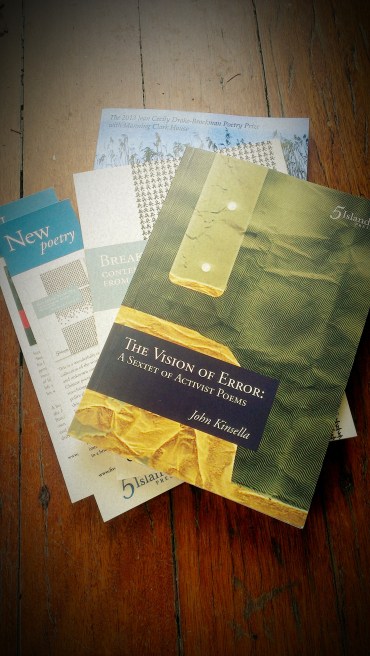
  • In 2014 (and beyond!) I’ll be helping out Five Islands Press, serving as their consulting poetry editor for Queensland. Their annual submissions window for poetry manuscripts closes on Nov. 30.
  • Voiceworks Magazine launches “Prime” at the 2013 Express Media Awards on Dec. 5. VW is always stuffed full of wonderful stuff. Broede Carmody (2013 Booranga Prize-winner for fiction; Whitmore Press Manuscript Prize finalist — such talent very babe wow) edited a poem I was lucky enough to have included. It is possibly my only successful sexy poem.
  • Tincture Journal launches its fourth issue on Dec. 1. Tincture is a fantastic digital publication — in fact, it has been nominated for the Express Media Award for “Best Project By/For Young Writers”. Nice one! They’ve kindly included a couple of my poems in the new issue.
  • A poem of mine has been included in the inaugural Jean Cecily Drake-Brockman Prize Anthology. Hooray! I think this is the first time I’ve been anthologised.

Today's mail

THEATRE REVIEW: Mary Stuart

Words: Tahnee Robinson

[At the OffStreet Arts blog, we’re launching this cool new idea: late reviews! It’s gonna take off! Belatedly! No, actually, apologies to QSE; this one got lost in the email vaults. Better late than never! — Ed.]

Under the direction of Christina Koch, the Queensland Shakespeare Ensemble has tried something new with their production of Mary Stuart. The parameters of the project are simple, but daunting; they are designed to push the ensemble to their limits and explore the possibilities of pulling a production together very quickly. The actors — with their lines already down — have had one week together to rehearse.

The choice of venue, the University of Queensland’s Geoffrey Rush Drama Studio, and the limited budget initially give the feeling of a high school or university production executed by consummate professionals. Angel Kosch’s costumes are creative and effective, but up close it’s evident that they have been restricted by financial concerns — Johancée Theron’s Queen Elizabeth is, I’m sure, wearing someone’s formal gown from the late 1990s. However, the professionalism of the company quickly overshadows this effect. Belinda Ward’s set is quite basic, too: a set of steps and a throne, and a lot of space for the actors to occupy, making maximum use of the Studio’s multiple stage entrances. The choice to include live music is very wise: the violin, cello and vocals by Imogen Eve and Wayne Jennings adds a level of polish that would be lacking if they had elected to use only prerecorded sounds.

Friedrich Schiller is, perhaps, a strange choice for such a project. Peter Oswald’s Tony-nominated version of the German original is lengthy and complex. However, for a Shakespeare ensemble there is a definite logic to the choice. The play is delivered largely in iambic pentameter, and the scheming political plot contains turns within turns, and layers of betrayal. It feels somewhat like a Shakespearean farce turned terribly serious.

The commitment of the cast, as a whole, is evident; there are a couple of fumbled lines but these are handled so as not to interrupt the flow. Some of the members are veteran Thespians, and it shows: Rob Pensalfini as the Earl of Leicester is the centrepoint of all this political scheming, and he executes each turn with a baffling conviction that is key to the moral ambiguity of the play. We are never quite sure that we understand what Leicester actually wants (other than to survive the narrative with his head attached) and it remains unclear whether he really knows, either. Flloyd Kennedy as Hanna, Mary’s loyal handmaid, is another standout. A guest to the ensemble, Kennedy’s part could be mistaken as decorative; however, she is flawlessly believable, drawing your attention while remaining unobtrusive. Nick James, an apprentice to the company last year and now a member of the core ensemble, plays a commanding Mortimer, who, on Schiller’s spectrum of reason to romanticism, is perhaps the character most driven by passion. James has just come from playing Lysander opposite Rebecca Murphy (Mary, Queen of Scots) for QSE’s A Midsummer Night’s Dream. During the post-performance Q&A session the actors openly speculate as to the effect this may have had on their rapport together for Mary Stuart.

The Q&A, held after every performance, is an intriguing exercise for the audience; it adds a layer to the experience of seeing the production that, under other circumstances, might be unwelcome. Instead you feel like you have become part of an intriguing theatrical experiment. The company is quite open about the potential pros and cons of doing a production this way. For a play as complex as Mary Stuart there are, undoubtedly, both. This method allows a certain rawness that might otherwise be polished off with weeks of rehearsing and workshops, as the actors come to expect the ways in which their counterparts will deliver and move. The downside is the slight suspicion that the actors are, occasionally, unsure about their characters’ motivations. While Schiller and Oswald have built a deliberate level of ambiguity into the play, if the actors are indecisive it can reveal a lack of conviction that’s not always part of the character.

MARY STUART ran at the Geoffrey Rush Drama Studio at the University of Queensland from 2 to 5 October, 2013.

Linkfest 3000: Victim Blaming Edition

Trigger warning for discussion of sexual assault, victim blaming and rape culture.

Well, technically this is the opposite of a “victim-blaming edition” — here’s a (growing) list of links with something sensible to say in response to Mia Freedman’s “tell your daughters not to drink” article of October 23.

There’ve been dozens of articles and probably thousands of tweets debating victim blaming, rape prevention, rape culture and survivor support in the last couple of weeks. It’s exhausting. If you’re interested in the discussion, you’ve probably experienced diatribe worthy of screencapping and sending to STFU Sexists. Hopefully you’ve had some productive discourse too. Here are some useful links you can use to support and encourage productive discussion surrounding rape prevention. Want to learn how to support survivors better? These are good for that too.

See also: Friedman, J and Valenti, J. 2008. Yes Means Yes: Visions of Female Sexual Power in a World without Rape. Berkeley: Seal Press.

Got another article or link worth adding? Let me know in the comments!

REVIEW: Aurelian

Words: Tahnee Robinson

The stage at Metro Arts feels like a house in storage: draped with muslin and shadows, the shapes suggest but don’t confirm. It’s a fitting scene for what is to come — Aurelian explores the nature of memory and grief, and the way we construct our lives around loss.

Aurelian is the work of Genevieve Trace and a small creative team. Trace describes herself as a multidisciplinary performer, and Aurelian certainly samples from a variety of creative forms. The performance uses film, audio samples, physical theatre, live recording and a collection of narratives to form a pastiche of recollection and identity. Opening with a monologue that verges on prose-poetry, we are awakened to the anxiety of grief; performer Erica Fields repeats, with increasing desperation, a mantra of sorts: “But I have to work these things in order.” This is the panic of the bereaved, sorting through memories distorted with obsessive recollection.

The performance takes us through a series of stories, interview-style. Fields, shadowed by co-performer Trace, nods and smiles and pauses, responding to a series of prompts and questions that are unspoken. She has captured the glossy, overwrought joy of the bereaved perfectly. We are sometimes not sure who she is — widow, grandchild, neighbour — but all of these characters speak with the earnest ardor of people trying to do their lost loved ones justice in the retelling. And these stories are real, sourced from people in Trace’s hometown of Ayr in northern Queensland. Amongst them seems to be Trace herself, or her character, trying to understand her own grief.

Aurelian

Around the halfway mark, the narratives speed up and begin to fragment. Mike Willmett’s sound design follows the theme: the soundscape squeaks and glitches with the failing of the characters’ recollections. The climax, an attempt to reconcile the irreconcilable, is a wall of noise and flashing lights. Whitney Eglington’s lighting design makes clever use of the abstract set. Images are projected onto unlikely surfaces and lights appear behind screens to cast unexpected shadows and figures. The set is mostly made up of a series of trapezoidal constructions in various sizes. These function as seats, benches, projector screens and, at one point, a washing basket. They’re unobtrusive, and Trace and Field can move them about the stage with minimal interference.

All of this combined is Aurelian’s weak point. In evoking the overwhelming incomprehensibility of grief the show has overreached a little. There’s just too much here, for 60 minutes worth of performance. I can help but wonder if the whole thing would have felt more effective if a couple of the elements had been removed. The concept of the supernatural, hinted at during the opening, is explored more directly here. This is perhaps a natural inclusion in a discussion of death and loss, but it feels out of place amongst so much musing on identity and memory. The concept, executed with lights and a semi-transparent backdrop, and clever use of the two performers, is visually effective. But feels like a bridge too far — one thing too many to think about in a performance that is already quite intense.

Aurelian doesn’t really conclude — there isn’t even a curtain call. And that’s thematically consistent. There’s no answer to grief, no cure or method for dealing with it and no way to manage the wrinkling and slippage of our memories.

AURELIAN played at Metro Arts from 7 to 15 September as part of Brisbane Festival.

TAHNEE ROBINSON is a Brisbane-based writer. She was OffStreet Press’s visual arts, film and fashion editor.

DANCE REVIEW: When Time Stops

Words: Tahnee Robinson

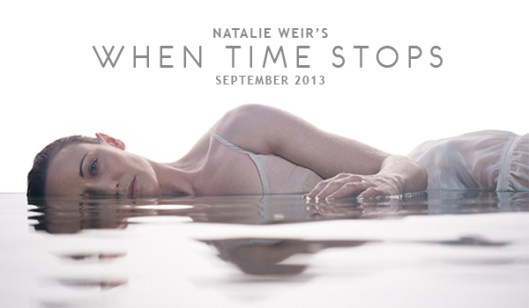
We awake in the underworld, on the banks of the river Acheron. The Ferryman (Thomas Gundry Greenfield) is rowing away from us. He will row for most of the performance, quiet and inexorable, as we linger by the river. He is a towering figure, but he is not unkind: he will wait patiently for his charge until she is ready. When Time Stops takes us through the last moments of a life, picked up in a rush of memories before making the final crossing.

Bill Haycock and Iceworks Design’s underworld is a beautiful creation, haunting but without malice, and deceptively simple. Comprised of mirrored surfaces and windows, backlit panes and a hidden door, the set is beautifully atmospheric and very flexible — a must for this performance, which places its entire musical ensemble on stage for parts of the piece. The lighting, designed by David Walters, is ingenious and integral, maintaining the subdued sorrow of the underworld but showing us glimpses of life — elation, love, terror — with a scattering of stars or a beam of sunlight falling across a face.

There are more musicians than dancers; Iain Grandage’s composition is performed by Camerata of St John’s, a chamber orchestra of string players sans conductor. There are 12 of them, and they move around and amongst the dancers as they play. This is no mean feat: creeping a bass, two cellos, two violas and seven violins around a stage occupied by a company of contemporary dancers in mid-flight is an extraordinary work of choreography and focus. The musicians are part of the performance — as they should be; the compositions are integral to the mood of the piece and to understanding what is being depicted.  The strings are perfect for this, their richness and many tones provide a degree of emotional nuance that is essential to our understanding of each section.

When TIme Stops (EDC)There are parts of When Time Stops that are particularly affecting. Broken into a series of moments of profound importance to the dying woman, it is largely up to the audience to imbue these impressions with meaning.  Amongst these segments is ‘First Kiss’, which stirs a sense of sweet nostalgia and innocence, reminding the audience of first-love elation without overstepping into melodrama. Later, there is ‘Scan’, which makes clever use of the set and lighting to imply a medical emergency of some kind — intimations of mortality revisited at the time of death. ‘Time’ is represented by a little silver orb, around which Daryl Brandwood dances with extraordinary feline skill and control; the orb is captured and released with joy and desperation.

The dancing is extraordinary, and each of the seven company members brings an intense commitment and control to the performance. They are uniformly graceful and astonishing, contorting themselves into impossible positions with complete fluidity and a superb awareness of each other. Natalie Weir’s choreography is inventive and intimate; The Woman (Riannon McLean) reviews her life with fear and longing, often reaching out to the visions she sees, embracing her memory of herself or her lover. It’s romantic, and often sexual, without being tawdry or overt; these intimacies are the highlight of the performance, as the dancers lift and hold each other, entwining and separating.

WHEN TIME STOPS by Expressions Dance Company is on at the Playhouse, QPAC, until September 14, as part of Brisbane Festival. Tickets $48–58.

TAHNEE ROBINSON is a Brisbane-based writer. She was OffStreet Press’s visual arts, film and fashion editor.