REVIEW: Blak

Bangarra Dance Theatre: BLAK

Words by Tahnee Robinson

It’s not often that each element of a performance — choreography, lighting, set design, smell — is beautifully executed in its own right. But Bangarra’s latest offering, BLAK, goes beyond that to create a performance both stunning in its attention to detail and deeply confronting as a whole.

Blak is slick and sharp, tightly controlled dance theatre that, despite telling its story through movement and metaphor, completely eschews artifice. There is nothing self-conscious here — and absolutely no apologies as the dancers use their bodies to tell stories of crime, violence, assault and grief.  The stage is often dark, but when the dancers look out they’re bold: they’ll look you in the eyes.

The performance is divided into three sections. Choreographed by Daniel Riley McKinley and the male dancers themselves, “Scar introduces us to gang of young men dressed in street gear.  Clad in dark, hooded clothing, their movements evoke a sense of sublimated violence, stalking the stage with fear and aggression as they navigate the difficulties of being young, male and indigenous in urban Australia. The men fall in and pull back from fighting and self-harm in a series of movements that fall somewhere between breakdancing and ballet. These sequences incorporate traditional elements that eloquently convey the opposing forces of modernity and tradition, and the difficult spaces available for young Aboriginal men to occupy and grow into.  Different pools of spotlight flicker between dark scenes of conflict. At one point the grinding, synthy soundtrack whoops into the unmistakable cry of police sirens and the group cease fighting, unified instead to flee.

Bangarra: Blak

Part two, “Yearning”, is choreographed in collaboration with the female dancers. It’s a change of pace — the movements are less violent, more sinuous — but the atmosphere is no less fraught, largely due to the music. David Page and Paul Mac have outdone themselves; they create a dark, electronic soundscape that incorporates traditional singing, vocal samples and instruments, with elements of trip hop and trap music.  A woman answers a call, illuminated by the sodium-lamp glow of a telephone box in the middle of nowhere in the dark of night. The music throbs and jitters; tension escalates in an eerie way that is reminiscent of some of Cliff Martinez’s recent film scores.

Jacob Nash’s set design is poignant in its minimalism. Single props are perfectly chosen to evoke a sense of place: a row of blue plastic chairs, a swinging spot lamp and a corrugated iron roof, glowing green in the dark. Beneath the eerie glow women sit atop milk crates and learn of a granddaughter’s suicide; a smoking tin can on stage wreathes their grief with incense. Their loss smells sweet and spicy and mournful; it lingers.

This beautiful simplicity continues as a small television — the old kind, a CRT with rabbit-ears — appears on stage.  Three women writhe on the ground. From the dark, a figure appears carrying a green spotlight; he’s filming them. As they dance in distress, they appear on the TV. We’re watching the film and reality in real-time, but we cannot focus on the domineering figure behind his lamp. The result is simultaneously deeply affecting and extraordinarily hard to articulate — a powerful, confusing motif.

The performance culminates in part three, “Keepers”, which features the full ensemble. The set is breathtaking: blackness lightens to reveal the gloss of wet rocks and light refracts off a stream of fog to create a waterfall. The dancers come together, with nature, to embrace both tradition and the future. This beautiful piece of work gives the performers room to show us the full range of movement, emotion and eroticism in their repertoire. It’s a tribute to love and community that ends a confronting performance on a note of optimism and possibility.

BLAK runs at the QPAC Playhouse until 27 July, 2013.

TAHNEE ROBINSON is a Brisbane-based writer. She was OffStreet Press’s visual arts, film and fashion editor.

REVIEW: Salõn

Salõn tips its fascinator to soirees of a bygone era, wherein powerful hosts welcomed underground artists into their own parlours. The show is choreographer Timothy Brown’s brainchild, developed in collaboration with its cast with the support of the Judith Wright Centre’s Fresh Ground artistic residency. (Read my recent interview with Brown to find out more.)

In terms of aesthetic, Salõn approaches the sublime. The Judy performance space has undergone several striking transformations of late, and this is one of them. Cabaret seating hugs a series of stages stretched over the space. Andrew Meadow’s lighting design evokes a boudoir decked out in indigo and red silks and velvets. Surreal costumes form the basis for haunting tableaux. In short, Salõn looks pretty damn good.

The Oracle and the Serpent: Michelle Xen and Travis Scott (photo by FenLan Chuang)

The Oracle and the Serpent: Michelle Xen and Travis Scott (photo by FenLan Chuang)

Michelle Xen and the Neon Wild, as “The Oracle”, provide the soundtrack, but there’s no orchestra pit here; the band is very much a star in its own right. Xen’s neon-electric costume changes alone could almost constitute an entire show.

As for the rest of the cast, Iona Marques ( “Alice”), a dancer trained in Rio de Janeiro, seems to be made of something more malleable than mere human muscle. She’s a charmer as she wanders between our tables; once on stage, she’s something else entirely. Das Unheimlich persists: mesmerising Anthony Trojman (“the Peacock”), perched above The Neon Wild, looks rather like the son of David Bowie in The Man Who Fell to Earth.

Nerida Matthaei, an accomplished dancer and choreographer who has just won a place on the 2013 Australian Korean International Exchange Program, seems uncomfortable in her role as ringmistress “Jean”. Even enthroned atop her “Things” (David Trappes and Alex Weckes-Hucks), Matthaei lacks the confidence to pull off her one-liners with the panache required to elevate them above the level of cheese. Elizabeth Whelan demonstrates the redundancy of dialogue as the silent “Marchesa”, omniscient host and patron, though her talents as a dancer are sadly under-utilised.

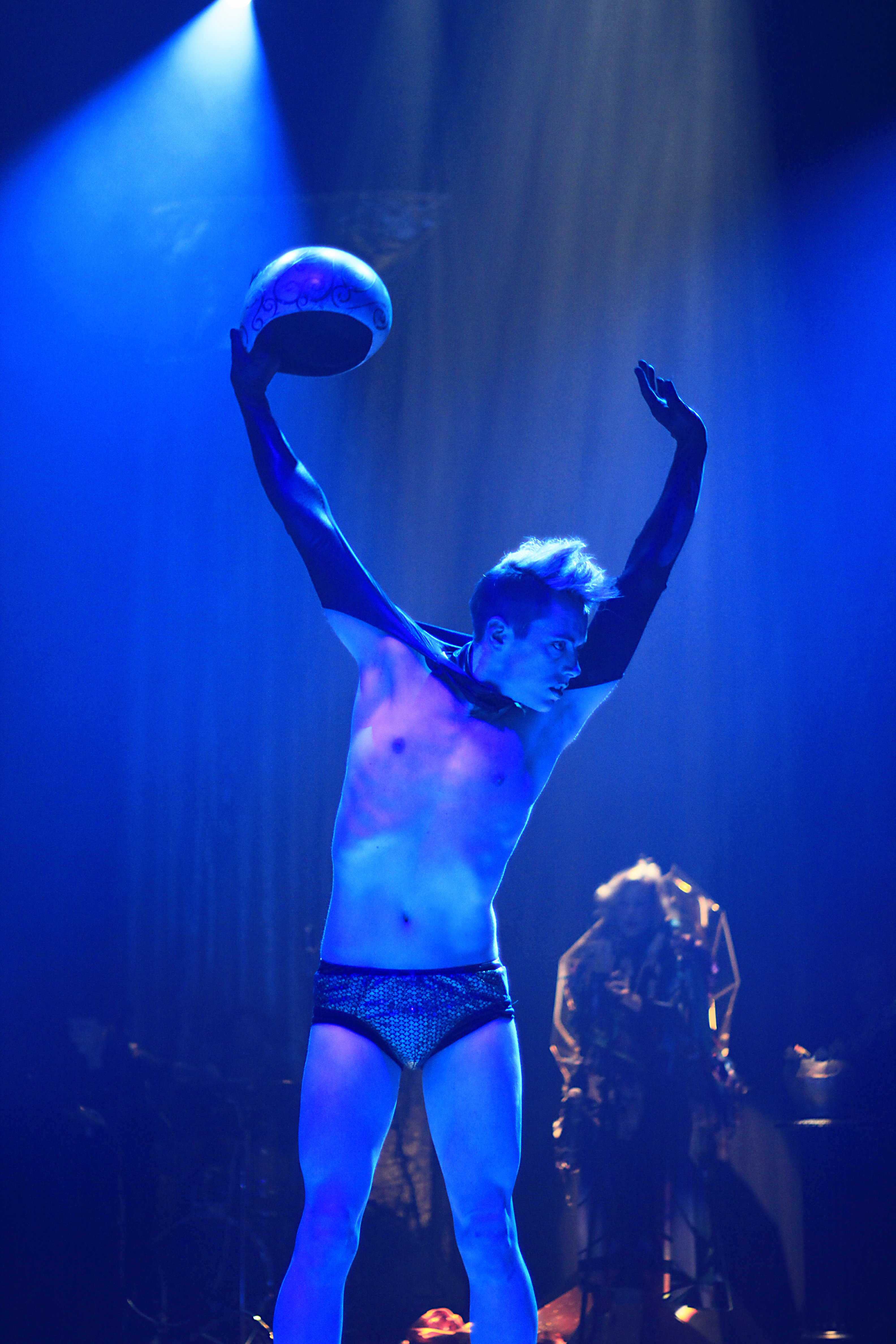
The Peacock: Anthony Trojman (photo by FenLan Chuang)

The Peacock: Anthony Trojman (photo by FenLan Chuang)

Bridging the divide between circus and dance, Travis Scott (“the Serpent”) ensures we’re awake with a suitably sinuous swinging pole routine. Trappes and Weckes-Huck’s acrobalance and juggling provide just the right relief to lighten the moody epicurean atmosphere.

While the links between acts are tenuous and the pacing occasionally lags, Salõn has a thematic cohesion that helps it to transcend an average variety night. Brown draws on elements of Weimar-era cabaret to create a sense of decaying decadence. His choreography is as slick as his Serpent’s scales. The audience is left with a dreamy impression of colour and movement, light and neon sound.

SALÕN runs at the Judith Wright Centre for only two more nights, till 29 June, 2013.

Reader-in-Residence: David Stavanger

The human half of the Holy Ghostboy, David Stavanger is Brisbane Square Library’s new Reader-in-Residence. I spoke to David to find out what this spoken word explorer has in store for our central Biblioteca.

ZENOBIA FROST: What was the book your forced your parents/babysitters/fairy godmother to read to you over and over as a child?
DAVID STAVANGER: The Story of Bip by Marcel Marceau. It is only lately I have realised what a subliminal influence it has been on the development of my alter-ego / other-self Ghostboy . . . not just in the look but even more so in the sense of play and absurdity of sadness. I also really loved Where the Wild Things Are and Green Eggs and Ham — again, both poetic, dealing in surreal imagery / other worlds and a sense of the outsider and their abandonment.

ZF: Can you name one book change you’d say changed your life or outlook when you read it?
The Picture of Dorian Gray by Oscar Wilde. I was in my late teens and it is just brimming with sex and the nature of desire, the way we ingest the world and what that does to us. I love its take on vanity and society too, and (later in life) these as a metaphor of self-doubt and the ongoing gratuitous need to be validated, noticed and loved by others. All artists should read it, then keep lying to themselves. [I stole Dorian Gray from the school library before it was remaindered and it had the same effect on me. — Z.]

Also, got to thank Mum for leaving the collected works and Bratsk Station by Yvengy Yevtushenko around at home. “Waiting” and “Colours” are two of my favourite love poems and “Weddings” still resonates as a great war poem for me.

ZF: Which letter in the alphabet is your favourite and why?
DS: I love V. Mainly because it was taken from my surname Stavanger, which had been truncated to Stanger in Australia back when. As Stavanger is a Viking name and that is my lineage, I decide to put it back via deed poll before I attacked any more villages. Also, villainous and vile and voluptuous rent in the same street.

Holy Ghostboy

ZF: The residency will deliver free workshops, competitions, events and performances. Tell me more!
DS: I came up with the idea based on a similar project that Edinburgh City Library in Scotland created about four years ago. I became good friends with Ryan Van Winkle, the poet behind the idea (we are bringing Ryan over to do a workshop, reading and installation as part of the project here). I went over and was mentored by Ryan in their program then spent months adapting and extending on it before pitching it to Brisbane Square Library as part of The Lord Mayor’s Writer-in-Residence initiative. And they said yes. The premise is kind of simple and direct — base a writer in a central library and get them to engage all library users with a chosen writing genre: in my case, poetry and spoken word.

I plan to use the Brisbane Square Library residency as a chance to spring poetry, in all its diverse forms, onto people. That includes me being a “live” reading and writing installation every Thursday, programmed and guerilla poetry performances throughout the building, workshops and collaborations with other local poets and artists, and even a poetry speed dating event so people can really get to know the poets in this town. We have some distinct voices and I have always been about poets getting more of their work out to people outside of the traditional poetry settings of the cafe reading or pub slam.

ZF: Where do you expect/hope to be (as a reader, as a writer, as a human, as a creature) at the end of the 12-month residency?
DS: Lots of things — I tend to start big then go bigger. Better to fall a long way than jump over the same picket fence. I am working on a number of possible legacy projects that are yet to get the green light but will involve a number of local poets; we will have given voice to the everyday poetry of the library via competitions and installations using text created by them; Brisbane Square will hopefully have one of the best poetry and spoken word collections in Australia; and more poets in Brisbane will not only see their work in Brisbane library catalogues but also borrow and read more poetry themselves (if poets aren’t, then why should anyone else?).

ZF: Which body part would you be willing to sell to fund your poetry? (Recently a Columbian poet announced he’d sell his testicles for $20000 to fund his upcoming tour.)
My kidney. I only have one and it is 90% fit, but man can it tell you some stories . . . plus, it would make for a great pie.

The year-long residency launches at Brisbane Square Library on 4 July, 2013, with live music from The Stress of Leisure and poetry from Eleanor Jackson and David Stavanger.

Judith Wright Centre: Salõn

Timothy Brown (Queensland Ballet, Expressions Dance Company) promises Judy audiences the exotic, the erotic and the sublime in The Salõn. He curates  seven physical performers — with backgrounds in circus and dance — in collaboration with musos Michelle Xen and the Neon Wild. It’s a showcase of local talent with international appeal; don’t miss out.

ZF: Salõn is an ambitious interdisciplinary work. How did you go about getting the balance just right, both in terms of aesthetic and the diverse cast?
TB: It was like creating a lavish yet unpredictable patchwork of acts, styles and artists genres.

ZF: With your dance background in mind, what were you looking for in your seven performers?
TB: The Salon performers are local independent artists who have proven to be outstanding in their fields while also creating their own unique niches within music, circus and dance.

Anthony Trojman — photo by Dylan Evans Photography, design by Blender

Anthony Trojman for Salōn (photo by Dylan Evans Photography, design by Blender)

ZF: Tell me one or two stunning, surprising or strange things about the character or talents of the performers.
TB: Travis Scott is a dancer come pole dancer come swinging pole dancer. This is very unique as there is only a small hand full of swinging pole artists around the world.
Former Expressions contemporary dance artist Anthony Trojman (pictured) is currently completing his honors in physiotherapy, with his last exam a day before we open!

ZF: How was “living work of art” Marchesa Luisa Casati an inspiration for the show?
TB: Marchesa Luisa Casati has always been an icon for me. Although this work is not a biography of the great Marchesa, the concept of icons, divas, and muses being immortalised through art are themes among others the show has drawn inspiration from.

ZF: How important was the Fresh Ground program to the show’s development? (Salõn was part of our JWC’s Space program introduced this year.)
TB: Fresh Ground is a unique program that I think gives the Judy a very important role in the independent arts sector. Artists need to have access to government facilities and support without too much paper work and admin. Just a studio with a speaker can give an artist a chance to create magic for Brisbane audiences and potentially show the world how good we are and what we have to offer.

ZF: If you were to paint a tableau that represented Salōn, what would it look like?
We have quite a few in the show! Very colourful, very diverse with a mix of glamour, grace, rebellion and cheek!

SALŌN plays at the Judith Wright Centre from 22 to 29 June, 2013.

Emma Dean: Beyond the Imaginarium

Brisbanite Emma Dean is in her element in New York, where the difficult-to-define performer has flown to chase her dream of making it big in the Big Apple. She hasn’t had to wait long; with the release of her White EP, the first in a trilogy, she’s already turning all the right heads.

ZF: You’ve been in the Big Apple for a few months now. What’s your favourite New York New, York story from your adventures thus far?
EM:
My favourite New York story happened when I was opening for the delicious Courtney Act at The Laurie Beechman. You may remember her as being the sexy drag queen with the killer pegs who stole she show during Aussie Idol. Just before our last performance, Cheyenne Jackson tweeted about my new single, “Phoebe (With Her Whole Heart)”. I’m a huge 30 Rock fan so I knew him as the devilishly-good-looking Canadian from the show. He is also a big Broadway star and pop singer. That night we got word that Cheyenne was hopping off a plane and coming straight to see me play! He is just as charming off screen as he is on. Quite surreal.

ZF: What’s the biggest difference and most surprising similarity between performing in Brisbane and New York?
EM:
The biggest difference is that I have to give a thorough explanation of my song “Tall Poppy” before playing it. The most surprising similarity is that I still stick out like a sore thumb.

ZF: How has the White EP been received thus far?
EM: We’ll see when the royalty cheque comes through in August, won’t we? Ha ha! In all seriousness, I’ve been amazed at the response. I was a little nervous because this EP was so different to my other bodies of work. But I was pleasantly surprised, especially by the live session youtube clips, which collectively have almost 33,000 views in less than two months.

Emma Dean

ZF: What’s the plan with White/Red/Black trilogy?
EM:
Red will be coming out some time in July then Black will be towards the end of the year. Both EPs will be released digitally and independently and have been recorded and co-produced by the talented man in the bowler hat, Mr Fronz Arp. Red features epic songs about love, lust and heartbreak performed on a grand piano with lush strings and harmonies. Black features rhythmic, jazz-influenced songs from the underground performed on a klunky upright pianaaa, double bass and pots ‘n’ pans! Guest performers on the EPs are Indigo Keane, Fronz Arp, Tony Dean, Janey Mac and my housemates in Ashgrove who became my impromptu clapping ensemble!

ZF: Will you be touring your new work to Australia in the near future, or workin’ on that New York career for a while yet?
EM: I’m creating a new show called “Imaginarium”, which will be an extension of some of my other work. It will be MD’d by James Dobinson and will also feature physical theatre performer and actor, Kate Lee. We will work as a three-piece chamber-pop ensemble incorporating piano, cello, violin, glockenspiel, drum machines, live drums and physical theatre. It would be an absolute dream to come back to Australia with this work. I’ll keep you posted!

ZF: What’s your advice to up-and-coming performers in Brisbane?
EM:
If you are an up-and-coming ANYONE in Brisbane, make sure you give yourself an opportunity to get out and see the world, grow as a performer or artist, support your brothers and sisters and begin to create a community. There is often enough to go around. And when there’s not . . . think outside the box.

EMMA DEAN’s White EP is now available as a digital download from iTunes, Amazon Music or direct from Candyrat Records.

REVIEW: Delicacy

Director Lucas Stibbard warns audiences that Delicacy is not a nice play — a wonderfully delicate phrase to use. This two-person, one-hour play, inspired by the life of German cannibal Armin Meiwes and his lover/meal, will make you squirm and cringe for what feels like hours. Although the show turns on the question of “will they or won’t they consummate their cannibalistic plan?” — a morbid twist on the old romantic trope — the characters’ domestic exchanges generate some of the most keenly felt discomfort.

Neil (Cameron Hurry), the character to be eaten, flits between psychotic bursts of aggression and agitated silence. Even when utterly still, as when he watches porn at the dining-room table, he vibrates with explosive unpredictability. Denny (Gregory Scurr) is a picture of passivity, absorbing Neil’s physical and verbal abuse to respond with praise and apologies, attending to Neil’s every whim. A review of an earlier production of Delicacy compares Denny to a manservant. In contrast, Stibbard and Scurr’s Denny, though servile, also achieves a fine layer of menace. If he feeds, praises and dotes on Neil, he does so in the manner of a attendant to a human sacrifice.

Costume designer Rachel Cherry transforms the mostly vegetarian Denny into a butcher figure with a simple transparent plastic apron. Their monochromatic clothes — Denny in pink, Neil in red — continually remind us of the blood, its flow and its release, that is at the heart of this play. Elongated silences punctuate Neil’s outbursts; in these silences Denny’s mask slips. Deep shadows in his eyes, created at these precise moments by Cameron Parish’s clever lighting, reveal a brooding and impenetrable core. These indirect touches sustain a brilliantly tense and uneasy mood in a play that is quite coy about the cannibalism that forms its gothic centre. Early on, our only clues are cryptic references in otherwise domestic dialogue.

Delicacy

Similarly, Bec Woods’ set is ever so slightly unnerving: recognisably domestic — a dining room and a kitchen — but exaggerated, distorted. The kitchen bench extends too far and ends up looking industrial. When Denny cooks, the kitchen dwarfs him. The dining room table seems huge with Denny and Neil crowded together in one corner. In stark contrast, a single, preposterously strong light above the dining table occasionally constricts the stage to illuminate just the table, creating a claustrophobic mood where before the space had seemed unmanageably large.

My one problem with the play involves its script. The story diverges quite significantly from the events that inspire it, which is not in itself a problem. The problem is that these divergences strip the original story of its interesting nuances. To recap the headlines, two otherwise likeable and normal-looking men, who shared affection, consensually agreed that one should eat the other. The men were well-regarded in their neighbourhoods — likable, relatable cannibals. It’s a true story that raises compelling questions.

On the other hand, Julian Hobba’s script turns both of these people into eminently unlikeable characters — selfish, childish, and violent — which immediately throws up a wall between them and the audience, letting viewers off the hook. There’s no chance that they will empathise with either Denny or Neil, short-circuiting the original story’s moral quandary.

Ultimately this play is not so much about cannibalism as it is a play that involves cannibalism. This story doesn’t plumb the depths of what it might mean to perform the act of eating another human, but it is a well-told gothic tale — tense, suspenseful, and shocking.

Delicacy runs at the Brisbane Arts Theatre until Jun 15. http://www.artstheatre.com.au

JEREMY THOMPSON was assistant arts editor at OffStreet Press. His work has been published in Small Packages, Rave Magazine, Voiceworks, and Notes From The Gean.

REVIEW: Briefs (Theatre People)

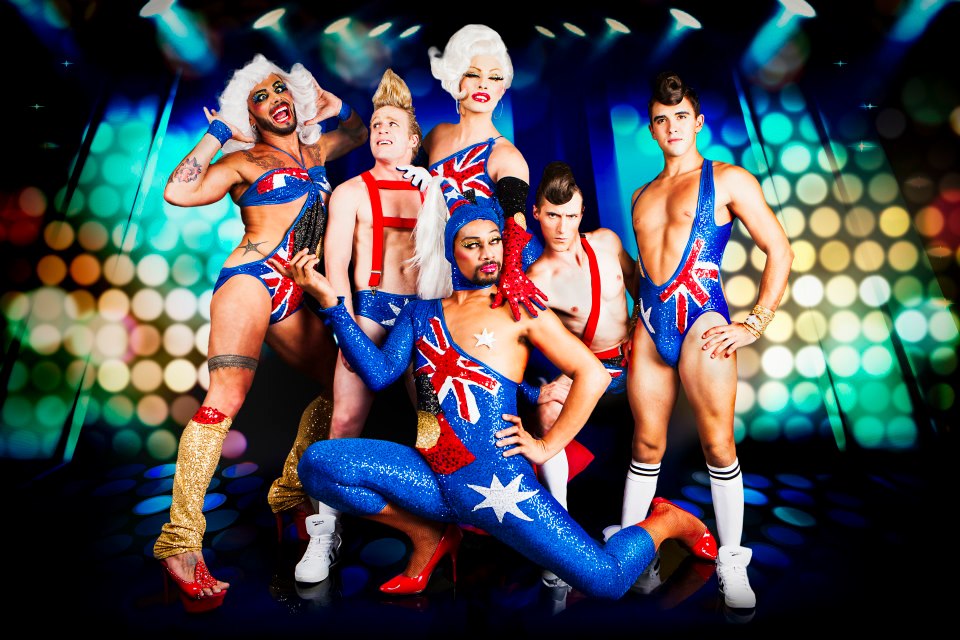
Brisbane is very proud of our Briefs boys, who are off to Melbourne and the UK next with their Second Coming. Follow the links to read my five-star Theatre People review:

It’s been a long time coming. Two years have passed since Brisbane’s own cabaret burlesque boys played on a home stage — not that they’ve abandoned us. The Briefs troupe has been all over Europe and Australia, getting the good word out: Brisbane is not — never was — the “cultural black hole of Australia.” We’re the circus capital.

Briefs founders Fez “Shivannah” Faanana and Mark “Captain Kidd” Winmill return to the Powerhouse with a fresh posse: Tom Flanagan, Dallas Dellaforce, Louis Biggs and Ben Lewis. Their chemistry… Read more.

Briefs: The Second Coming (photo by Sean Young)

Briefs: The Second Coming (photo by Sean Young)

REVIEW: Live on Air (Anywhere Fest)

Live on Air is the only Anywhere Fest show this year to truly go anywhere. Comedy-poet Telia Nevile’s pirate radio show streams from her lounge room into yours, wherever you are. 

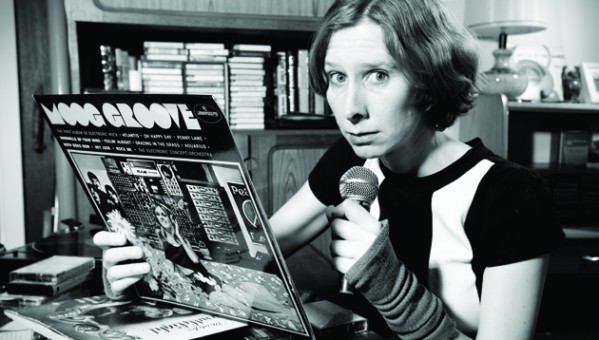
Logging into Live on Air feels like checking in to Skype with a friend. Nevile turns on her webcam and broadcasts live from a homely couch in a Melbourne living room. Black-and-white posters of writer-rockstars plaster the rear wall; Oscar Wilde features, along with his epigram: “I have nothing to declare but my genius.” Nevile wears a homemade shirt that says, “Rimbaud Built My Hotrod”. From the get-go, we know this is erudite comedy. Bring it on.

Relia Nevile

Live on Air takes the format of a radio variety show, interspersed with power ballads, pop and even a bit of grammar grindcore (“Apostrophe Apocalypse”). Nevile’s poems form the heart of the show. Each follows an extended metaphor (e.g. “‘Eros’ is Just ‘Sore’ Spelled Backwards”) via one-liner witticisms. To the tune of Satie on piano, Nevile explains that she’s “deep (in thought)” but you’re deepest “when you’re six foot under.” As well as poems, there’s fiction — both flash and slash (West Wing fan fiction, to be precise).

Nevile is a strong performer and the setting (from her couch to yours) makes for an intimate performance. Rather than feeling tucked away in the privacy of home, I keep forgetting that the video is only one-way. It feels rude not to respond with, at the very least, applause. Perhaps we need a talkback line.

Comedy is an incredibly subjective beast. Nevile’s poetic brand of funny doesn’t quite tickle my funny bone, but I do appreciate her commitment to satirising form. The “poetry cabaret” variety show, delivered here via webcam in the manner of radio plays, is a fantastic format. Live on Air also proves that performance can be just as intimate online as on stage.

LIVE ON AIR ran from 8 to 16 May, 2013. Anywhere Festival.

REVIEW: Sons of Sin

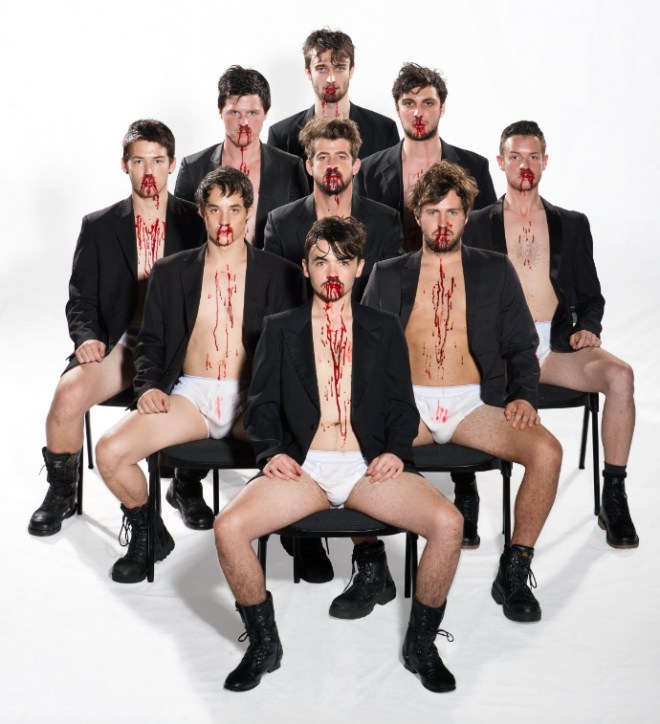
A bathtub. Giant playing cards. Splattered blood. Casting a circle around these few props, nine bearded young men crack open bottles of beer. In turn, the audience circles the party: we are at once voyeurs, witnesses, accusers, accomplices and confidants. 

The Danger Ensemble vows to “question what theatre is and re-vision it for the future.” Whatever your take on this unusual production, you’ve gotta hand it to ‘em — the ensemble’s visions are bold, brave and compelling.

Sons of Sin, directed by Steven Mitchell Wright, takes the form of a game. The cards lie facedown before the performers; which ones they draw, in turn, will determine the shape of the show. One card grants the audience permission to name any dare; another demands the creation of a new group rule or the confession of a secret; yet another signals the unfolding of a surreal tableau.

No two shows are the same, and it’s likely you’ll see things you’ve never seen in a theatre space before. You might even be the one to suggest them.

Sons of Sin

For the nine actors (Alex Fowler, William Horan, Thomas Hutchins, Aaron Wilson, Ron Seeto, Chris Farrell, Samuel Schoessow, Charlie Schache and Stephen Quinn), Sons of Sin is an incredibly demanding show. It’s luck of the draw what they’ll need to perform next, from prepared monologue to improvised violence to nude scenes. The cast’s chemistry holds this show together; they seem to possess a hive mind. Collectively, they possess a burning, restless energy that makes it hard to tell one from another.

Sons of Sin explores the condition of the modern “lost boy” — risk-taking 20-somethings with energy to burn, anger to bottle and insecurities to drown. There’s no overarching narrative; rather, the characters expose more of themselves, piece by piece, through the game.

The show covers a lot of ground, but its chance nature prevents Sons of Sin from becoming an exhaustive survey of masculinity — good move. That said, the cast avoid some fantastic opportunities for development; when an audience member asks, “You’re white, male and middle class — why are you so angry?” during a session of “truth”, the question is fobbed off as boring, and we return to questions about masturbation, sharting, etc.

It’s an interesting work to compare with Daniel Santangeli and Genevieve Trace’s Room 328 (Metro Arts, Brisbane Powerhouse) and Sven Swenson’s The Truth About Kookaburras — both Brisbane productions concerning Lost Boys. (Incidentally, Brisbane stages have seen a lot of cock in the last few years. Just pointing that out.) In style, Sons of Sin is closest to Room 328, but in tone it is much more intimidating. The sons’ power dwells, tossing and turning, in their unpredictability.

I admit I’m immediately won over by any show that invites me in. In an immersive production, it can be just as interesting to watch the audience as the performers. You’ll speak with, drink with and probably touch these men, and it’s impossible not to be absorbed into their chaos. A warning, though: wear clothes you don’t mind getting wet or even stained. Fluids will fly. (Funnily enough, I had a glass of wine spilled over me not by a performer, but by a fellow audience member. Oh, well.) And do be aware that Sons of Sin is confronting and changeable.

By Z. Frost

The Judith Wright Centre has gutted and transformed its main theatre space for this show. For anyone who regularly visits the Judy, it’s aptly disorienting. The JWC website states that Sons of Sin may run for anywhere between 90 and 110 minutes. We got more bang for our buck (or review comps, yes); opening night’s running time, interval included, was closer to 150 minutes.

In the second half, the incredible demands on the cast start to show; the performers’ energy begins to waver, and so does ours — especially as motifs repeat, by chance. (After nearly two and a half hours of standing, following, ducking and dancing, the audience swarms from the theatre towards somewhere to sit down.)

Sons of Sin works best in its scenes of action — whether spontaneous or choreographed — as well as moments of reflection. The show suffers from dense, shouted monologues that cause the game to lag. The Sons already show their sins so well, there’s often no need to tell. The inclusion of a verbose climax suggests that Wright and co-devisors don’t trust the game to speak for itself. It does.

Sons of Sin holds up a broken mirror to a culture of casual violence. If you let them, The Danger Ensemble will take you on a wild, exhausting, worthy ride. Wear a raincoat. Pick your poison. Think up some wicked dares.

SONS OF SIN runs at the Judith Wright Centre until 25 May, 2013.

Review: The Travelling Sisters Let Loose (Anywhere Fest)

Review by Nerissa Rowan

It’s the last night of the Anywhere Theatre Festival, and the show is sold out. We meet on a street corner, before being led down a dark alleyway. What awaits us? Should we be frightened? Is this a trap?

But from behind the trees emerges a brightly lit garden surrounding a beautiful old Queenslander. The verandah is full of waiting audience members, drinking tea, coffee and hot chocolate. It has the feel of a garden party, as we run into people we know, chat and take in the surroundings.

Soon the front doors open and we are led into a spacious living room. I settle on a mattress piled with cushions, closest to the fireplace. The atmosphere is friendly, and we feel we’ve arrived at a friends’ party. When the hostesses arrive, there are magic tricks and party games which get everyone joining in. Tonight is clearly about having a good time.

The Travelling Sisters Let Loose is a comfortable cabaret, which loosely links stories, songs and traveller’s tales. Lucy Fox and Ell Sachs tell us how they found this “abandoned” house, and how they’ve passed their time since — bathing in memories and music. They wander the room, so no matter where you sit, you’ll be in the perfect spot for some part of the action.

The subject matters are many and varied, including love, loss, losing face and losing inhibitions. Whether fact or fiction, they feel like personal stories, told with real emotion in conversational style, in song or in poetry. The songs are quirky and clever, and the voices are beautiful. One epic song is accompanied with a gorgeous animation projected on a wall.

Throughout the night, the audience is treated to snacks. The relaxed atmosphere helps us feel that we can sing along or clap in time to the music just as we would among friends. Some are asked to help build a blanket fort. It would be difficult not to smile — but why would you try?

The Travelling Sisters Let Loose is an enormously warm feel-good show. It’s staged like a family concert — but my family is nowhere near as talented as this pair. I look forward to finding out what new adventures they will take us on.

The Travelling Sisters Let Loose ran from 8 to 19 May, 2013. Anywhere Theatre Festival