REVIEW: Sons of Sin

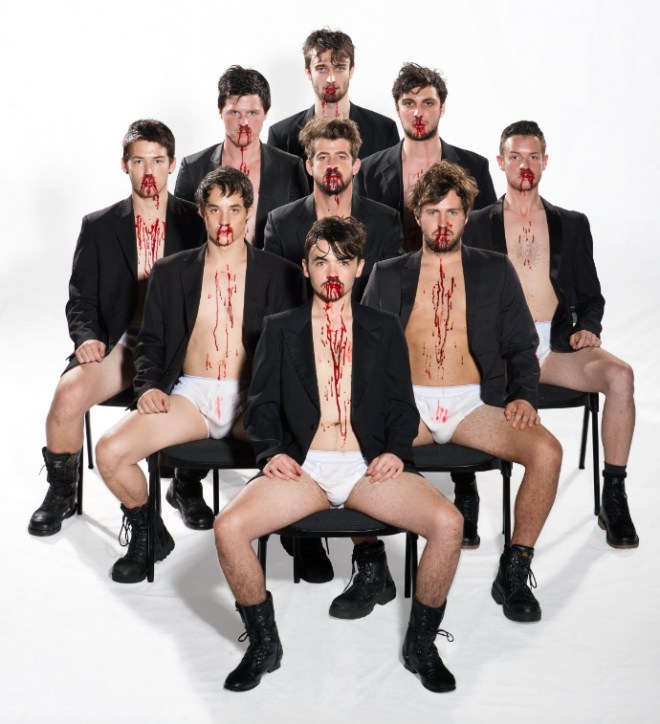
A bathtub. Giant playing cards. Splattered blood. Casting a circle around these few props, nine bearded young men crack open bottles of beer. In turn, the audience circles the party: we are at once voyeurs, witnesses, accusers, accomplices and confidants. 

The Danger Ensemble vows to “question what theatre is and re-vision it for the future.” Whatever your take on this unusual production, you’ve gotta hand it to ‘em — the ensemble’s visions are bold, brave and compelling.

Sons of Sin, directed by Steven Mitchell Wright, takes the form of a game. The cards lie facedown before the performers; which ones they draw, in turn, will determine the shape of the show. One card grants the audience permission to name any dare; another demands the creation of a new group rule or the confession of a secret; yet another signals the unfolding of a surreal tableau.

No two shows are the same, and it’s likely you’ll see things you’ve never seen in a theatre space before. You might even be the one to suggest them.
Sons of Sin

For the nine actors (Alex Fowler, William Horan, Thomas Hutchins, Aaron Wilson, Ron Seeto, Chris Farrell, Samuel Schoessow, Charlie Schache and Stephen Quinn), Sons of Sin is an incredibly demanding show. It’s luck of the draw what they’ll need to perform next, from prepared monologue to improvised violence to nude scenes. The cast’s chemistry holds this show together; they seem to possess a hive mind. Collectively, they possess a burning, restless energy that makes it hard to tell one from another.

Sons of Sin explores the condition of the modern “lost boy” — risk-taking 20-somethings with energy to burn, anger to bottle and insecurities to drown. There’s no overarching narrative; rather, the characters expose more of themselves, piece by piece, through the game.

The show covers a lot of ground, but its chance nature prevents Sons of Sin from becoming an exhaustive survey of masculinity — good move. That said, the cast avoid some fantastic opportunities for development; when an audience member asks, “You’re white, male and middle class — why are you so angry?” during a session of “truth”, the question is fobbed off as boring, and we return to questions about masturbation, sharting, etc.

It’s an interesting work to compare with Daniel Santangeli and Genevieve Trace’s Room 328 (Metro Arts, Brisbane Powerhouse) and Sven Swenson’s The Truth About Kookaburras — both Brisbane productions concerning Lost Boys. (Incidentally, Brisbane stages have seen a lot of cock in the last few years. Just pointing that out.) In style, Sons of Sin is closest to Room 328, but in tone it is much more intimidating. The sons’ power dwells, tossing and turning, in their unpredictability.

I admit I’m immediately won over by any show that invites me in. In an immersive production, it can be just as interesting to watch the audience as the performers. You’ll speak with, drink with and probably touch these men, and it’s impossible not to be absorbed into their chaos. A warning, though: wear clothes you don’t mind getting wet or even stained. Fluids will fly. (Funnily enough, I had a glass of wine spilled over me not by a performer, but by a fellow audience member. Oh, well.) And do be aware that Sons of Sin is confronting and changeable.

By Z. Frost

The Judith Wright Centre has gutted and transformed its main theatre space for this show. For anyone who regularly visits the Judy, it’s aptly disorienting. The JWC website states that Sons of Sin may run for anywhere between 90 and 110 minutes. We got more bang for our buck (or review comps, yes); opening night’s running time, interval included, was closer to 150 minutes.

In the second half, the incredible demands on the cast start to show; the performers’ energy begins to waver, and so does ours — especially as motifs repeat, by chance. (After nearly two and a half hours of standing, following, ducking and dancing, the audience swarms from the theatre towards somewhere to sit down.)

Sons of Sin works best in its scenes of action — whether spontaneous or choreographed — as well as moments of reflection. The show suffers from dense, shouted monologues that cause the game to lag. The Sons already show their sins so well, there’s often no need to tell. The inclusion of a verbose climax suggests that Wright and co-devisors don’t trust the game to speak for itself. It does.

Sons of Sin holds up a broken mirror to a culture of casual violence. If you let them, The Danger Ensemble will take you on a wild, exhausting, worthy ride. Wear a raincoat. Pick your poison. Think up some wicked dares.

SONS OF SIN runs at the Judith Wright Centre until 25 May, 2013.

Review: The Travelling Sisters Let Loose (Anywhere Fest)

Review by Nerissa Rowan

It’s the last night of the Anywhere Theatre Festival, and the show is sold out. We meet on a street corner, before being led down a dark alleyway. What awaits us? Should we be frightened? Is this a trap?

But from behind the trees emerges a brightly lit garden surrounding a beautiful old Queenslander. The verandah is full of waiting audience members, drinking tea, coffee and hot chocolate. It has the feel of a garden party, as we run into people we know, chat and take in the surroundings.

Soon the front doors open and we are led into a spacious living room. I settle on a mattress piled with cushions, closest to the fireplace. The atmosphere is friendly, and we feel we’ve arrived at a friends’ party. When the hostesses arrive, there are magic tricks and party games which get everyone joining in. Tonight is clearly about having a good time.

The Travelling Sisters Let Loose is a comfortable cabaret, which loosely links stories, songs and traveller’s tales. Lucy Fox and Ell Sachs tell us how they found this “abandoned” house, and how they’ve passed their time since — bathing in memories and music. They wander the room, so no matter where you sit, you’ll be in the perfect spot for some part of the action.

The subject matters are many and varied, including love, loss, losing face and losing inhibitions. Whether fact or fiction, they feel like personal stories, told with real emotion in conversational style, in song or in poetry. The songs are quirky and clever, and the voices are beautiful. One epic song is accompanied with a gorgeous animation projected on a wall.

Throughout the night, the audience is treated to snacks. The relaxed atmosphere helps us feel that we can sing along or clap in time to the music just as we would among friends. Some are asked to help build a blanket fort. It would be difficult not to smile — but why would you try?

The Travelling Sisters Let Loose is an enormously warm feel-good show. It’s staged like a family concert — but my family is nowhere near as talented as this pair. I look forward to finding out what new adventures they will take us on.

The Travelling Sisters Let Loose ran from 8 to 19 May, 2013. Anywhere Theatre Festival

Review: Mixtape (Anywhere Fest)

Review by Nerissa Rowan

“I’ve made you a mixtape.”

Sure, it’s an old-school concept — but you may remember a time when there was nothing more romantic than getting a mixtape of music chosen especially for you. Each one had a special meaning, hidden or overt. It was an intimate journey for a couple.

Scott Sneddon and Angela Willock allow us to eavesdrop on their mixtape conversation, as they get to know each other through the medium of music. It’s a show punctuated with recorded music as they play each other the soundtracks of their lives. There are some touching stories and embarrassing confessions — there are always songs we loved that will come back to haunt us.

In short, it’s a series of poetic love letters to the good and not-so-good music of our youth. Each track has a story behind it, a rationale for being included be it a happy memory, a moment of discovery or an admiration for musicians who change our lives.

But it also examines the beginnings of a relationship, the fears, hopes and taboos that come with starting something new. There were a few moments of awkwardness which could have been excellent acting, or genuine nervousness. In this kind of performance it’s difficult to tell.

With a show like this there is plenty to relate to. It sparks memories of falling in love — be it with a girl, a boy or a song. It might make you think back on your own teenage years, consider the songs that shaped you and what your own biographical mixtape might contain. It celebrates awkward dancing and knowing all the words to the most embarrassing songs.

This is an enjoyable and well-constructed show that kept me captivated to the end. Mixtape will leave you with a smile on your face. Do yourself a favour…

Mixtape runs at the Rabbithole Cafe from 16 to 17 May, 2013. Anywhere Festival.

Nerissa Rowan is a poet, performer, Arts Hub reviewer, and former OffStreet PressGang member.

Review: Skin & Wake Up (Anywhere Fest)

Anywhere Festival double bill: “Skin” and “Wake Up”
Reviewed by Nerissa Rowan

Skin

There’s a lot to be said for knowing your limitations as a viewer. As much as I love watching performers push the boundaries of theatre and the performing arts, I’m not a big fan of the abstract. I like only a fraction of abstract art, as I prefer something with a clear narrative.

And a unifying story is the one thing Skin doesn’t deliver for me. The Anywhere website says Skin explores real and fictional stories of body modification and tattoo culture through physical theatre. It’s an accurate description but the show was still not what I expected. The stories are in the form of brief snippets of song, monologue or movement that leave me feeling unfulfilled.

I’m certainly open to the idea that I missed the story, and that I’m a lazy viewer. But I find there are too many gaps to fill in: the progression from opening song (which is hauntingly beautiful) to the close seems a little unnatural. It just didn’t come together as a cohesive whole.

However, the show did have clear themes running through it. Themes of body image, conformity, the beauty myth, sensuality and control.

It was also great to see an Anywhere show bringing out extra chairs for a very healthy crowd. Taking place outdoors at The Box in West End, a sheet hung across the back corner to create a backstage space. The sounds of the Brisbane Boxing training space drifted through a nearby window, creating a fitting soundscape for a piece about physical self-expression.

The four performers, armed only with balloons, marking pens and mobile phones, create a tableau that I’m sure many people could relate to, although for the most part I didn’t feel emotionally engaged.

If you want to get the most out of a festival like Anywhere, know your limitations as a viewer and choose your performances accordingly. You will enjoy this piece if you are fascinated by dance, movement and the cult of body image.

SKIN runs at The Box, 29 Vulture Street, West End, from 15 to 16 May, 2013. Anywhere Festival.


Wake Up

Alastair is an ambitious professional whose work comes first — except on his day off. His day off is a time for him. Not his girlfriend Ange, who he claims to love but actively ignores. Not his mother, who still loves him despite the fact he constantly tells her to go away. Not his friend in need of a helping hand.

Situated outside at The Box in West End, the set for Wake Up is minimal. A white sheet hung from the wall provides a canvas on which Alastair’s colourful and disjointed dreams are projected. He sleeps on a makeshift bed, with only a mobile phone for company. A phone that rings constantly with unwanted calls.

This one-man show is more monologue than multimedia, but talented actor Benjamin Jackson keeps it moving at a good pace. He has created a character who seems concerningly familiar and not entirely likeable, as he uses half-truths as excuses to disconnect from his fellow human beings.

If I hadn’t seen The China Incident earlier this year, which took the concept of introducing characters by telephone to new heights, I would likely have been blown away by this show. Unfortunately, I found myself drawing comparisons to the Queensland Theatre Company production.

While this production is more low-budget and low-key, it has many of the elements that made The China Incident successful. The actor is focussed and believable, the timing is spot on and the monologue provides just enough detail to allow us to imagine the other side of the conversation. There’s a balance of laugh-out-loud situations and reflective moments, with the additional aspect of slickly produced dream sequences.

Writer, director and stage manager Mikhala Hawken has created a play she can be proud of, with a clear message to Wake Up to ourselves.

WAKE UP runs at The Box, 29 Vulture Street, West End, from 15 to 17 May, 2013. Anywhere Festival.

Nerissa Rowan is a poet, performer, Arts Hub reviewer, and former OffStreet PressGang member.

Anywhere Fest: Ma Ma Ma Mad

Merlynn Tong (Zen Zen Zo) has microphone in hand for her one-woman spectacular, MA MA MA MAD. Her other hand is outstretched to you, her audience. Enter Cyber City.

Q. Describe your show/s in under 25 words.
A. A one-woman dark-comedy offering set in a Karaoke bar that dives into the landscape of my mother’s heart as she enters the realm of suicide.

Q. Anywhere Festival is about making art everywhere. What makes your venue unique?
A. My venue (2002 Cyber City) is perfectly insane. As you enter the space, an Asian lady surrounded by DVDs and VCDs stares at you. Then the aromas of Chinese food awaken your nostrils. As ginger and garlic make their greeting to your senses, the melodious Chinese language and repetitive sounds of the arcade machines tempt your ears, beckoning you closer. Right at the end of the venue, in a tiny Karaoke room fit for only 20, we begin our journey. Gosh, I love this space! So central in the Valley, when I first stepped in 2002 Cyber City, it was like discovering a playground in my own backyard.

Merlynn Tong

Q. If your show were a new My Little Pony, what would it look like? What would its superpower be?
A. I have never watched My Little Pony before (tsk tsk Singapore!). [It’s a show, now? I must be stuck in the 90s. — Ed.] But I reckon this should have been on my TV screen when I was a kid.

Q. What’s your favourite karaoke standby?
A. Absolutely have to sing “Silent All This Years” by Tori Amos! I just have to add that my mother’s standby is “Yesterday Once More” — I’ve heard her sing this a million times when I was growing up. Her character in my show seduces the whole audience to sing this song with her!
MA MA MA MAD plays at 2002 Cyber City, Fortitude Valley, From 16 to 18 May, 2013. Anywhere Festival.

REVIEW: The Nightingale and the Rose (Anywhere Fest)

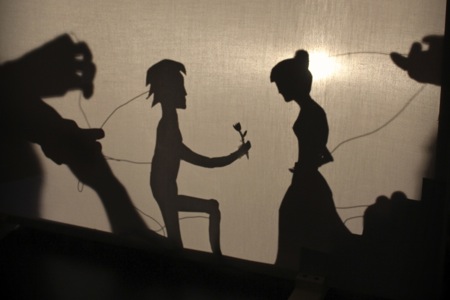
Directorial team Jennifer Bismire (live production, puppetry and design), Belinda McCulloch (film) and Richard Grantham (music) transform Oscar Wilde’s tale of “love perfected through death” into a multimedia performance piece. Published in 1888, Wilde’s short story tells of nightingale’s sacrifice for a young student in need of a red rose to give his beloved. The parable unfolds through puppetry, text, film and music across seven screens in the Powerhouse Labyrinth and Ruins.

Let’s get any biases out of the way: I know key members of the team, and very much respect their work. (After a while, it’s hard not to know at least someone in any given Brisbane show.) Still, I trust them to trust me to review honestly.

There’s something mystical about shadow puppets. These articulated silhouettes are deftly handled by a large cast of puppeteers (Caitlin Marie Adie, Emily Bruce, Perie Essex, Eloise Maree, Lauren Neilson, Helen Stephens and Sami Van Barneveld).

The garden, across three screens, takes centre stage. At the far left, subtitles tell the Nightingale’s tragic story. On the other side, a live-action film plays out philosophical conversations between the Student and his professors. It’s a very different way to view a show; The Nightingale and the Rose is part-theatre, part-cinema and part-art installation, with the mood of a silent film. You don’t want to miss a thing — but there’s a lot to follow, and missing some (at least from the front row) is inevitable.

The Nightingale and the Rose

The filmed portion introduces new characters to Wilde’s story: two professors who consider the Nightingale’s plight as a thought experiment and guide their lovelorn Student. Wilde’s narration is split between these three figures. With regard to adapting a seven-page story for an hour-long show, it’s a clever idea; however, John Grey, Michael Croome and Tim Gollan’s performances feel unprepared and their dialogue lacks the conviction to transcend its role as a collection of leftover witticisms.

For the show, Grantham has arranged compositions based on works by Lili Boulanger and Olivier Messianen. His evocative performance transfixes, transporting us from the Powerhouse Ruins into the Nightingale’s garden. Still, the presence of the outside world is part of what makes Anywhere Festival different — you can’t stop passers-by chattering, nearby meditators chanting or car headlights flashing, so you may as well embrace the ambient soundtrack. I admired the cast, in particular, as they pressed on during an outburst from a gentleman who verbally abused an usher. (Yes, it’s a ticketed event in a public space — deal with it.)

It’s brave to stage this quiet, thoughtful piece outside of a traditional theatre space. Interestingly, some audience members behave more like cinemagoers: some chat while others even come and go. In last week’s interview, Bismire raised a pertinent question: “How many forms do we have to saturate a contemporary audience with to get across the same story?” Bismire, McCulloch and Grantham’s production is beautiful, but in the attempt to appeal to all types of viewers the story’s simplicity is sacrificed — along with the Nightingale.

The Nightingale and the Rose runs in the Powerhouse Labyrinth and Ruins from 9 to 18 May, 2013. Anywhere Fest.

REVIEW: My Struggle (Anywhere Fest)

My Struggle: The Life and Times of an Individ
(In a World Full of Hipsters)

Reviewed by Nerissa Rowan, May 8.
Presented as part of the 2013 Anywhere Theatre Festival.

You may think hipsters are a little crazy, rather intimidating or totes groovy. Whatever your perspective, this sub-cultural satire is unlikely to change it, but it will make you laugh.

Melding film, dance, music and impressive bad facial hair, My Struggle: The Life and Times of an Individ (In a World Full of Hipsters) takes three bored soldiers into a parallel universe where their best friend has become an art school hipster. In the hope of being able to get home, they help him on his quest to snag the girl of his dreams.

So it’s a love story, right? Not so much. It’s mainly a satire, looking at the price of cool, the dangers of expectations and the pitfalls of conforming to non-conformity. Or maybe that’s not what it was about and I wasn’t cool enough to work it out. Whatevs.

There are a few intense moments which may take you by surprise to add depth to what would otherwise be a light and enjoyable comedy. It’s not difficult to see the parallels being drawn here, yet I let my guard down while giggling at the stereotypes, and the menace caught me almost unawares.

The talented cast make full use of the space. Most of the action takes place on the bare stage, with the curved white wall of this photography studio creating the perfect canvas for projecting the filmed action and backdrops. But the actors move through the audience, up the stairs and into the bar on the upper level.  By the end of the piece all of us, from those perched on the bar stools to those on our low slung chairs closer to the main action, become part of proceedings.

It’s worth noting — as many people were caught out by it — that the 75 minute running time listed on the website does not include an interval. Starting just after 8, the show ended at 9:50pm. This is particularly important if you’re catching public transport.

So squeeze into your tight jeans, slip on your ironic shirt and lace up your vintage sneakers for a fun and thought provoking night. Although you might want to see this one before it becomes cool, you’re too late.

I give it a big green tick.

My Struggle: The Life and Times of an Individual (In a World Full of Hipsters) runs at SYC Studios, 37 Manilla St, East Brisbane from 8 to 11 May, 2013.

Nerissa Rowan is a poet, performer, Arts Hub reviewer, and former OffStreet PressGang member. 

REVIEW: Frankenstein

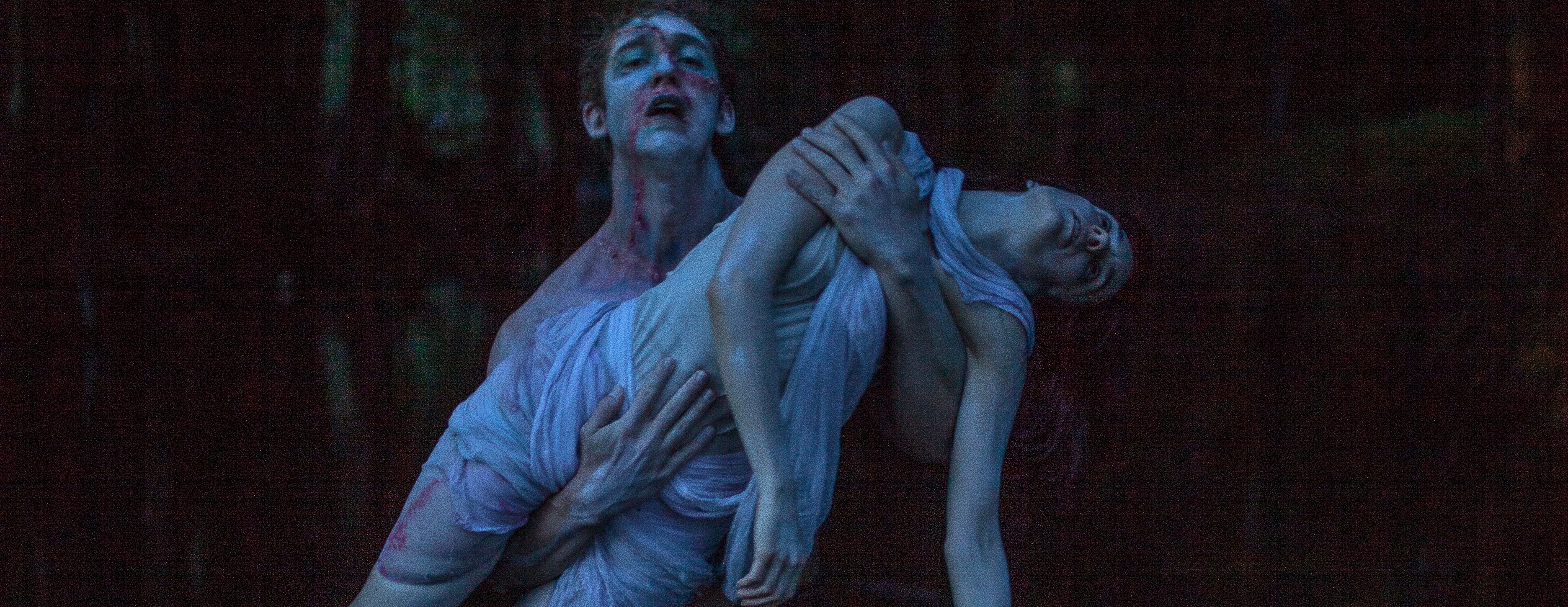
Fractal Theatre reanimates the Gothic horror in a new adaptation of Mary Shelley’s Frankenstein, playing at Brisbane’s beloved Arts Theatre.

Inside the theatre, Chancie Jessop’s design is immediately striking, transformed by Geoff Squires’ lighting from arctic wilderness to velvet-draped living room, from graveyard to dense forest. The repeated motif of da Vinci’s Vitruvian Man is a fitting tip of the hat to Frankenstein as an early — if not the first — science fiction novel.

Brenna Lee-Cooney directs a strong cast in a production that perfectly captures the atmosphere of the English Gothic novel, in all its ruined finery. Coached in movement by Brian Lucas, the cast at once embodies the grotesque and the burlesque. Characters tiptoe, jerk and twitch across the stage as if we are really inside a life-size puppet theatre. The result is a mood as funny as it is unsettling. (It occurs to me that BAT would make a wonderful variety cabaret venue.)

Frankenstein

Andrew Lowe takes the lead as Victor Frankenstein, a man troubled by his conscience — and its literal manifestation in his monster (Cameron Hurry). Hurry is superb as the reanimated creature — vulnerable, frightening, alluring, and very human. Thomas Yaxley makes a wonderful comic sidekick of Victor’s friend Clerval. Likewise, Zoe de Plevitz stands out as Victor’s betrothed, the long-suffering Elizabeth. It’s interesting to see Eugene Gilfedder take a back seat, supporting this cast of up-and-coming young things as various paternal archetypes.

Frankenstein skids along at a fast pace, but Lee-Cooney’s adaptation is too loyal to the source text. At two and a half hours, Fractal’s Frankenstein gets bogged down in the dense language of the novel (published in 1818). With the exception of our time with the creature, there are few moments of reflection; to pack the story in, every spare second is crammed with dialogue or narration. One can’t help but feel that a freer approach might have allowed more breathing space, and more time for design and movement to resonate with the audience.

I rather like seeing professional productions play in the low-tech, cosy Arts Theatre. Minor technical issues — such as Eugene Gilfedder’s atmospheric compositions competing with the actors’ un-miked voices — soon even out as we settle into the play. While overlong, Frankenstein delights with its interpretation of the Gothic as spooky melodrama.


Frankenstein plays at Brisbane Arts Theatre until 18 May, 2013, with two midnight performances on 4 and 11 May.

P.S. In the first half, my biro rolled away, never to return. However, broggling about under the seat in front in the interval, we did find two different pens in working order. The Theatre is a generous mistress.

Food: Item Not as Described

Trigger warning: discussion of sexual violence. (Also, relevant to that trigger warning: spoiler warning.)

La Boite describes Food as a “feast for the senses with an erotic mix of words and movement.” Critics call Steve Rodgers’ new play (directed by Rodgers and Kate Champion) sensual, a hilarious rom-com, soul food — “It will make you happy” (Stage Milk). Reading these reviews, I began to wonder if I’d seen a different play.

In Food, two sisters run a backwater takeaway joint inherited from their mother. Elma (Kate Box), the responsible elder sibling, is resigned to the daily heating up of Chiko Rolls until laidback Nancy (Emma Jackson) convinces her to transform the family shop into a restaurant. They hire charming Turkish traveller, Hakan (Fayssal Bazzi), to help out. From here, it’s well-trodden territory: the restaurant becomes a roaring success and Hakan spices up their lives as well as their cooking.

Anna Tregloan’s design is fantastic; the set features one central table against a backdrop of pots and pans. Clever projections transform these into glowing moons that frame home movies — the sisters’ childhood memories.

All action — highs and lows — takes place in this kitchen, and most of it whilst chopping vegetables. Needless to say, food is very important to Food. But it’s a stilted kind of food preparation, always pausing for conversation. I find myself wondering how the Chiko Rolls ever make it to the fryer. It makes me nervous. Handing out soup and wine to the audience is a nice touch, but being fed during shows is becoming more commonplace in the trend towards immersive theatre, and that puts the onus on each meal to do more. Mugs of minestrone abandoned after the show suggest that this scene is more of a distraction than a treat.

Box and Jackson

For Food, Rodgers collaborates with dance theatre company Force Majeure — something I was surprised to be reminded of after the show. The emphasis on movement is subtle or, at least, less rhythmic than it is frenetic.

Nothing lacks in the casting. Box, in particular, gives a genuine performance as the stoic Elma. It is uplifting to watch Elma realise her potential, and value, as a restaurateur. Jackson plays an intriguing Nancy, while Bazzi as Hakan makes an interesting transformation from happy-go-lucky pixie dream boy to entitled Casanova.

The trouble is that Food isn’t sure what kind of play it wants to be. It opens with Nancy dancing; increasingly, her movements become distressed, controlled — she is raped by an invisible presence. Cut scene, and we meet Elma and Nancy in the kitchen — where most of the play takes place. The sisters bypass the fourth wall now and then to narrate recollections in, variously, in the first and third person. Thus we flit back and forth between horrifying memoir (including several other instances of sexual assault) and cheery kitchen repartee.

When Hakan enters, pulling focus with a dramatic monologue and slideshow of his former lovers, the tone changes again — so much so that this scene is almost a play within the play. In some ways, this makes sense (he is the catalyst that’s meant to change the sisters’ world) but no transition is smooth. Likewise, while the women’s third-person monologues dissociate them from their pasts, they also promote Food’s overarching stylistic inconsistency.

It’s little wonder Elma and Nancy would want to distance themselves from the childhood memories they recount to us (in vivid detail), which include an instance of gang rape. But these sexual assaults, a source of tension between the older and younger sister, are never truly addressed — they serve to explain Nancy’s promiscuousness and sudden disappearance years before, and likewise to explain (in part, at least), Elma’s struggle with eating disorders. They’re scenes played to disturb the audience and garner sympathy, but these revelations don’t change the story or heal the characters.

The character of Hakan fulfils the cliché of the exotic traveller, just passing through, bringing with him a ray of sunshine. But this kitchen hand claims he can’t help but ogle a beautiful woman. (Elma points out he looks at Nancy “like she’s a steak.”) In the workplace, he sneaks up behind Nancy to embrace her. One failed seduction later, and he sets about taming the shrew instead.

So where is the burning sense of the erotic in Food that everyone’s talking about? It can’t be the slow top-and-tailing of beans, nor the minestrone, nor the Chiko Rolls. It’s certainly not the gang rape of a teenager by her peers while her sister waits outside. So it must be the creeping Casanova, overwhelmed by passion, who just can’t help himself. Given the women’s backstory, that this predatory sexual entitlement goes unchecked is problematic — unnerving, rather than erotic.

Rodgers’ script is thoroughly Australian in its sense of humour, yes. Moments of wit and playfulness shine through family drama and heartbreaking disclosures. But is it actually a comedy? I’d wager it belongs firmly on the drama shelf, far away from foodie feel-goods and tragi-comic comedies. But ultimately, it’s a shallow drama — with no one but the restaurant really changed by the end. Uplifting? I’m confused.

As a final note, as you enter the Roundhouse there’s a sign warning that the play contains course language, adult themes and simulated sexual intercourse. That’s a very different matter from themes of sexual violence, mentioned nowhere on that sign or on the website blurb — but appearing repeatedly in the play. I know it’s not just me who takes these themes into account when choosing what to see. On their booking page, La Boite takes the time to advise that “not all audience members will receive food.” Yet a warning regarding explicit sexual violence is overlooked.

Rodgers relies on “women’s issues” like sexual violence, eating disorders and fraught mother-daughter relationships to introduce pathos to a play that never intends to develop its three leads, who perform admirably in the face of a shallow script.

“It’s really about wanting,” says Rodgers in an interview with the Sydney Morning Herald. “Wanting intimacy with people, wanting the love and sex that feeds you and that can complete you, settle you.” Food tries to explore the desire for intimacy in the face of sexual trauma, but to do so Rodgers and Champion needed to handle Nancy and Elma’s childhoods with the depth, subtlety and sensitivity they deserved. That way, their moments of joy would have been all the more uplifting for the contrast. Alas, I certainly found Food wanting.

Food runs at La Boite until 27 April 2013.

The Birdmann in The Events of Momentous Timing

“The queen of Highgate Hill,” Tigerlil opens for the Birdmann with The Unrehearsal, a show that revels in the art of practised incompetence. Tiger Lil falls, spins, tangles and trips with perfect comic timing through a series of routines: whip-cracking, hooping, and puppetry. Tigerlil is always a pleasure to watch; however, each segment of The Unrehearsal feels overlong — if only by a little. From hooping to hoop skirts, she brings us to her stunning finale: a dextrous, devilish puppet climbs the skeleton of her undergarment to the boneyard tune of Waits and Burroughs’ “‘T’ain’t No Sin”.

We refresh our wine glasses and it’s time for the Birdmann’s Events of Momentous Timing. Billed as a one-man mystery, we join the Birdmann — in tails, tie, and tight black pants, with a plastic bag sticking out of one pocket — as he awakens from unconsciousness. Just how did our hero find himself handcuffed to an ironing board, holding one gorgeous black stiletto?

The Birdmann

The show follows a loose narrative through several events that help the Birdmann recreate that fateful night of the blackout. His mannerisms — simultaneously awkward and suave, and indeed birdlike — are the key to his comedy. The Birdmann shifts between cabaret-style one-liners (in the Aussie-noir tradition of Paul McDermott, Flacco and friends) and comedic circus feats. He defines this stylistic divide by dragging his plinth — the ironing board — to and from stage right.

It’s hard to take your eyes off the Birdmann. There isn’t exactly one word to describe him — and even the ones I’ve had to settle for don’t quite suffice. He has an eerie command of the surreal, but combined with that, an endearing — almost heartrending — dorky lonesomeness. As an example, this singular artist manages to have us screeching with laughter as he serenades and face-mashes a cupcake — his favourite comfort food and dietary supplement — but he tugs at our heartstrings too.

I won’t spoil the show for those yet to see it. The Birdmann’s mysteries are better unravelled in person. But he brings together a tenuous narrative with surprising cohesion and concludes with what can only be described as a stage spectacular worthy of Cher.

The Events of Momentous Timing, supported by Tigerlil, ran at the Judith Wright Centre from 23 to 24 March 2013.