Escape from the Breakup Forest

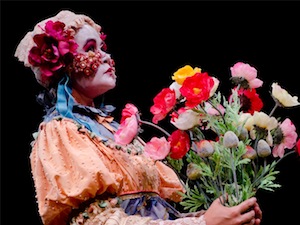
Escape from the Breakup Forest (directed by Claire Christian and Ari Palani) is the Brisbane debut for Toowoomba’s Mixtape Theatre Collective, who formed in 2011. The show’s cut-out-and-colour-in forest set pieces take root in the Judith Wright Centre’s Shopfront.

The Shopfront is a good space for Mixtape’s intimate offering. The border between stage and audience is just a line of masking tape. We share the casual cabaret seating with a fellow critic, whom I hadn’t seen years, and a traveller who bought a ticket on a whim.

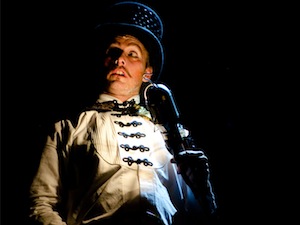
Steve Pirie, as Josh, takes the lead in a plot as simple as “boy loves girl; girl leaves boy; boy meets puppet.” The collective take their time telling the story of Josh’s romantic youth and eventual delirious five-year spin with Emma (Ell Sachs) — which ends in three years of red wine, Special K, and Friends re-runs. The real action starts when our mopey protagonist wakes up in a mystical land, the Breakup Forest, and meets Curly (puppeteering by Dan Stewart).

Escape from the Breakup Forest is one part Boy Girl Wall, one part Scott Pilgrim, and one part fresh-but-relatable comedy. In the mystical Breakup Forest, Josh must battle the memories of his exes and others who’ve hurt him. The narrative style (even some sound effects) seems heavily influenced by the work of Brisbane’s Escapists. Regardless, this production — along with the collective’s proactive attitude to making and funding theatre — suggests there’s more to come from Mixtape. And I’ll be watching.

Escape from the Breakup Forest

Pirie is one multitalented chap: he wrote and designed Breakup Forest, as well as performing the central role. Suitably pitiable as Josh, he embodies the role with just the right amount of charisma. Despite lingering on Chapter One, the scriptwriting is sharp. The cast has our motley table of viewers laughing together — and frequently.

The monochromic set design, along with projected animations, brings to mind “Elmo’s World” or, for a more grown-up audience, Don Hertzfeldt’s “Rejected”. Coloured lighting works really well in this regard, but could be harnessed more often. The cast, wearing white tees with details gaff-taped on, use cardboard props as costumes and weapons as they flit between roles. Sachs proves herself to be a versatile actor as she plays a series of Josh’s challengers: the female friend who dotes on him, the “slut” who rejected him in grade nine (a problematic character), and (signal boss fight) the memory of his ex-girlfriend Emma.

Unfortunately Curly’s simplistic design is limiting. Despite Stewart’s best efforts, Curly lacks the individual spirit we’ve come to expect from Muppet-like hand puppets — a pity, as he proves to be a major player in Josh’s story. But perhaps Escape from the Breakup Forest’s fatal flaw is optimism; in the end, the play takes a saccharine and all-too-easy escape route. While it might be a common fantasy, few dumpees as dedicated to red wine and re-runs as Josh can tap together their ruby slippers and vamoose; this particular wood is dark and deep, and there are usually miles yet to tread — on foot.

The Mixtape Collective’s Escape from the Breakup Forest plays at the Judith Wright Centre until 23 March 2013.
Dancing with Bach

Judith Wright Centre, March 6

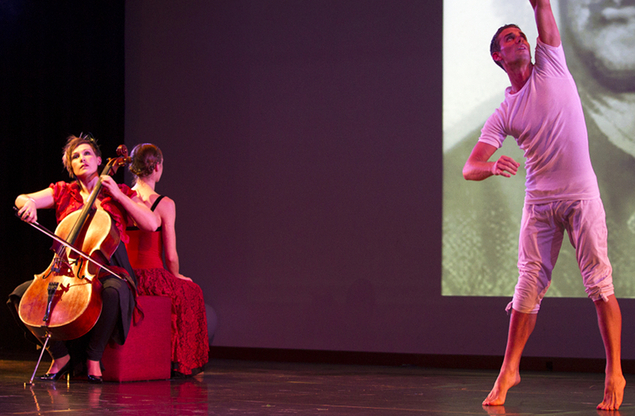
Bach’s Cello Suites were amongst the first suites of classical music to work their way into my bones. Lucid Dance Theatre’s Dancing with Bach project, choreographed by Louise Deleur in collaboration with cellist Louise King, aims to evoke the feeling of the suites as well as to paint a portrait of the composer’s life and work through dance.

But first, before Bach, we are shocked into a short piece called Surge — a lightning storm of a dance piece, performed by two sinewy figures upon a beach. The visuals are engrossing, with the dancers silhouetted against shoreline. We can almost smell the salt in the air.

There’s a 10-minute break that is determinedly not an interval: house lights go up, pop music hums, the stage is set for the main event — but we can’t leave our seats. At last, lights go down and bow meets cello. King’s performance is fluid and captivating. It’s easy to focus on her body language, but the dancers too are worthy of attention. They do more than dance to the music; the aim is to perform the suites with the body.

Dancing with Bach

Dancing with Bach is a work developed through the Judith Wright Centre’s Fresh Ground program. It’s an interesting production in this theatre space. With cello the only accompaniment, the thud of dancers’ feet on stage reverberates. In some ways, this focuses us on the dancers’ visceral movements; in other ways, it’s distracting. (You could hear a pin drop — or the sound-techs whisper.)

I always try to state my biases: dance is something I’m only learning about. For me, Dancing with Bach is an unsubtle piece — a little heavy-handed, heavy-footed. Rikki Mason dances the role of Bach himself, with Melissa Tattam and Elizabeth Barnard. Their danced relationships are intimate and tense, yet perhaps it is the sonic-emptiness of the space that makes communicating this intimacy to the audience difficult. Projections on a tall, thin screen illuminate stories from Bach’s life and, in this manner, we are unnecessarily told that we “find a world of emotions” in the suites — something the performance itself inherently seeks to show. The show don’t seem confident that the music will guide the dancers’ movements and our reactions and, as such, Dancing with Bach never seems to get the timing just right.


Dancing with Bach played at the Judith Wright Centre from March 6 to 8, 2013. 

For a different point of view, I liked this review at SameSame.com.au.

Holding the Man

La Boite, February 26

I first saw Tommy Murphy’s adaptation of Timothy Conigrave’s memoirs half a decade ago. It was a devastating experience then, at Brisbane Powerhouse in 2008. Thus it is that I have no excuse for my rookie mistake at La Boite: I have forgotten tissues. David Berthold returns to direct the story of Conigrave, a Melbourne actor and playwright born in 1959 whose high school love affair would last a lifetime — albeit a tragically short one.

There are two distinct halves to Holding the Man: the youthful comedy of act one, and then the slower march of act two. To say it’s a play about AIDS would be to sell Conigrave’s work and life short; rather, it’s about life: growing up gay in Australia in the 1970s and 80s, being in love, making mistakes, and negotiating family, politics and health.

The frank dialogue sets the pace for act one. Murphy’s script is refreshingly open about sex — enough to cause a few jaw-drops in the audience. We share the stalls with a class of Year 11 drama students in uniform — from my personal experience at a religious high school, this must sure beat any sex education they’ve had to date.

Alec Snow is the right man for the job as Tim; we are immediately on his side as he casually woos the gentle athlete, John Caleo (Jerome Meyer). Murphy has translated their voices authentically to the stage; their sincerity is the quality the play pivots around.

Holding Man

As we dash through the decades, we meet a kaleidoscope of queer archetypes played by a strong supporting cast: Eugene Gilfedder, Helen Howard, Jai Higgs and Lauren Jackson. The cast are made vulnerable by on-set costume changes in amongst mirrors bedecked with stage lights. It’s a good choice — in Holding the Man, everything is exposed.

Throughout this, Tim and John’s relationship develops and wavers. Then the 1980s bring their horrific revelations. Act two slows its pace: while the epidemic rages, each tragedy is deeply personal. The strongest scenes play out as fevered amalgams of drama workshops and medical scenarios — these whirlwinds make our hearts thump with the protagonist’s confusion and fear.

At times, the ensemble seems a little uncomfortable with the staging. But then, Holding the Man isn’t really a play in the round, and this is the Roundhouse Theatre. Still, the discrete elements of Brian Thomson’s design are striking and effective, and Micka Agosta’s uncanny puppetry makes the play’s final scenes resonate. If 2008 is anything to go by, those chills may resonate for years.

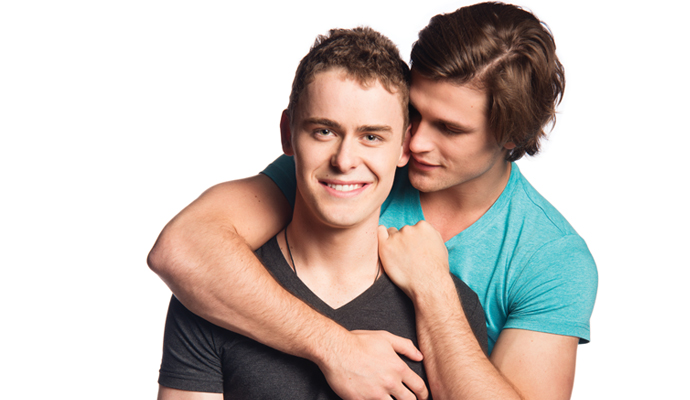
It’s easy to look back on the 70s and 80s and think about how much Australia has changed for queer people, their friends and families. But the poster for Holding the Man (pictured) has Snow and Meyer in a pose evocative of Queensland Association for Healthy Communities’ now-famous “Rip & Roll” campaign of 2011. Last year Queensland Health defunded QAHC, which provided HIV prevention services to local LGBTIQ communities. It’s a pertinent time to revisit Conigrave’s story, and to ensure that it does resonate.

Holding the Man runs at La Boite until March 16.

Can’t Be Artsed #5: All The Things

This week, while I should have been attending to The To-Do List, I instead attended a diverse bunch of artsy gigs. It was pretty rad. I should be studying/working/poeting/editing, but I wanted to at least jot down some thoughts before I lose ’em.

Henry Rollins, May 3

I’d never heard of Mr Rollins, nor his career with punk band Black Flag, before friends gifted me a ticket for my birthday. I decided to head in blind and find out what this spoken-word maestro has to offer on the fly.

Continue reading

No Mere Freak Show

Review: Edward Gant’s Amazing Feats of Loneliness

In a word, Edward Gant’s Amazing Feats of Loneliness is sumptuous. Renée Mulder’s set design and Damien Cooper’s exquisite lighting transform La Boite into a worn, warm big top. Finally, this theatre space—often a difficult one to negotiate—puts its best foot forward, rivalling the Spiegeltent for ambience with a raised, tilted platform that evokes a spider web of carnival memories.

Anthony Neilson’s script is rich pickings: witty, ridiculous, poignant, irreverent, poetic and absolutely spellbinding. “In a world where death is at our shoulder every hour,” says Gant “even the smallest act of creativity is a marvellous, courageous thing.” The show is a paean to imagination. Emphasising that “the truth of life lies least of all in the facts,” the over-arching story is revealed through a series of plays-within-the-play (not entirely unlike the layers of Gilliam’s Imaginarium).


Australian designers Romance Was Born have created wonderful costumes for a show that draws so much inspiration from the days of travelling carnivals. Every inch of the cast seems to sparkle, though I am glad Edward Gant (self-professed “prodigy, soldier, traveller, poet but always and ever a showman”) has such a glorious, glittering cape to distract from a fake potbelly that never quite looks right. The cast of four play numerous roles, from their carnival selves to teddy bears who just want some imaginary tea, whilst clever staging enables a chorus of pimples, bursting with “cheese,” to dance for us. Delicious.

I’ll admit that Paul Bishop is not the kind of Gant I expected, but his voice is perfect and he wears that moustache with finesse. Occasionally, perhaps uncomfortable in the role, he overplays Gant by mere inches and loses the confidence he needs to be ringleader. Bryan Probets* slips most effortlessly into his role as Jack Dearlove (and others), and seems the most versatile and genuine of the cast. Emily Tomlins (recently seen in Julius Caesar) is less convincing—she never quite disappears into her characters—while La Boite newcomer Lindsay Farris is competent, but like Tomlins never quite melds into the setting, unable to lose the Athletic Young Australian Bloke vibe.

Sarah Goodes clearly has a steady hand as director, and Steve Toulmin’s music delivers. With so much working in the play’s favour, the stage certainly was set for a mind-blowing performance. But, as I watched, I couldn’t help but be conscious of the fact that the cast were Actors (with a capital A) only pretending to be carnies. Possibly I go to more circus than is healthy. None the less, this La Boite/Sydney Theatre Company co-production delights, disgusts, enchants and surprises with what must be called amazing feats of theatre.


*I read, in his bio, that Bryan Probets was in the great Aussie vampire flick, Daybreakers. I was certain I remembered him as a vampire scientist working for the baddies. Turns out he was a subsider (a very uncivilised vampire indeed) in full make-up, so there’s no way that I actually remember his face. Memory is so fallible…but “the truth of life lies least of all in the facts,” right? Right?

Edward Gant plays until June 12 at La Boite. You can read my interview with composer and sound designer Steve Toulmin at Rave Magazine. What did you think of the show? Tell me in the comments section below.

Photos by Al Caeiro for La Boite.

3…2…1—Lift-off (of WTF11)

Brisbane Powerhouse put on a very fine evening of drinks and nibblies at the launch of World Theatre Festival this week. I liked the idea of WTF from the beginning because it meant Ben Law’s face was on posters all over Brisbane and every time I saw one, I remembered The Family Law and giggled. (Ben, are you even part of WTF, poster aside?) The festival itself has a great line-up from Europe, the USA, Chile and NZ, as well as home-grown talent.

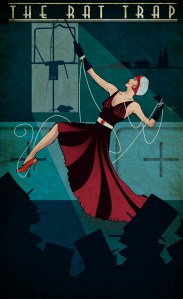
While we clutched our free wine and cider (the twittersphere keeps mentioning the WTF cider!), The Rat Trap, part of the festival’s Scratch Series of works-in-progress played out on the Turbine Platform. Sure, Polytoxic’s latest work is a little rough around the edges, but the audience was enraptured. With great costumes and a fantastic soundtrack (CW Stoneking and Amanda Palmer, together at last), the Polytoxic crew showed off some very promising choreography. I particularly loved the remote-control ratties and the swinging-from-the-lampshades dance routine. I wanted more from a one-trick strip to Palmer’s Missed Me, and couldn’t help but feel that the Siamese twins with the ping-pong balls were getting a bit too close to being offensive. But that’s what the Scratch Series is about—trying things out and trying things on, and The Rat Trap hit the mark far more often than it missed. With a bit of polish and tightening up, this will probably have the same obsession-creating effect on me that Cantina had at last year’s Brisbane Festival.

Apollo 13: Mission Control is an “interactive, intergalactic theatre piece” from the Land of the Long White Cloud. I was really excited to be one of the 100 “staff” working at Mission Control to help safely launch and land the Apollo 13, so I was a little disappointed when I ended up in the Press Gallery, looking on. Luckily, the friend I brought along managed to get in right up the very front, in the middle of all the action. The set is fantastic; audience members sit at 1970s-style computer consoles with functioning phones and video and shiny buttons. The cast went around sprucing up the new staff by handing out ties and tubs of Brylcreem. We (the pretend press) were handed a clipboard to jot down questions for the astronauts. We were all ready to be lifted off into funland.

The difficulty with a show like this—a recreation of a shuttle launch—is how to turn it from a historical event into theatre. Punters at consoles were given (rather involved) manuals to read, equations to solve, numbers to ring, and questions to answer, but ultimately nothing the audience did had any effect on the plot or characters. From the press gallery, there were lots of flashing lights and goings on—and lots of shouting—but I couldn’t see much meaningful interaction. I enjoyed the chats with the newsreader (great moustache!) and the astronauts, but my favourite scenes in the control room involved my buddy up the front hijacking the set, taking hold of a microphone, and making an air filter out of a tissue box, a vacuum tube, and sticky tape. His feedback was that the play felt like it couldn’t choose between serious re-enactment and freeform play. When he steered Apollo 13 in the latter direction, faces in the audience lit up.

At its worst, it felt a bit like a dud Thank God You’re Here segment; at its best, it was a joyous and chaotic rush of actors and punters playing together whilst machines made exciting pinging noises. I saw a lot of genuinely bored and anxious faces sitting at consoles, which is certainly a pity—but I think the cheers, when our astronauts came safely back to earth, were genuine too. There were moments when we felt like we were part of something momentous. I just wish there’d been more of those.

Find out more about WTF at: www.brisbanepowerhouse.org or you can check out my previews in Rave Magazine.