Legally Blonde: The Musical

You won’t hear me say this often — but Oh. My. God, you guys! Legally Blonde, the stage musical adaptation of the film of the same name, is as bouncy, bright and shiny as Elle’s blonde locks. In case you missed the 2001 film, Legally Blonde follows Elle Woods — a ditzy, rich Malibu girl in search of a husband — along her journey to discover her own intelligence, drive, and inner beauty.

It may be that we’re coming to expect musical extravagance from anything John Frost (no relation, as far as I know) has a hand in producing. But Legally Blonde goes above and beyond. Its staging, choreography (Jerry Mitchell) and design (David Rockwell) are pretty close to flawless, from Elle’s towering Barbie-pink Delta Nu sorority house onwards. This is as glossy as musical theatre gets.

Mitchell’s choreography, in particular, has a way of drawing the eye towards detail — in costume, body language, or lyric — without losing sight of the bigger picture. Musically, Legally Blonde’s score (Laurence O’Keefe and Nell Benjamin) is no classic. The opening number, “Omigod You Guys”, is an instant earworm and “Chip on My Shoulder” is a resonant study-anthem, but beyond that the songs only really serve to carry us along through the plot. That’s not to say there aren’t lots of laughs — there are. The dialogue (Heather Hach) is sharp and sassy, if not terribly self-aware.

Lucy Durack (WICKED’s Glinda the Good Witch) is an exceptionally strong singer. She plays an endearing Elle more reminiscent of Clueless’s Cher (Alicia Silverstone) than Reese Witherspoon. Along with her shrill-voiced “Greek Chorus” of Deltu Nu sorority girls, her energy and optimism is infectious. When Elle arrives dressed as a Playboy bunny to a stuffy academic do, her confidence in the face of humiliation deserves the cheer it gets.

Rob Mills rose to fame on Australian Idol, and he’s in his element as the smooth, douchey Warner. David Harris channels dorky-but-charming Joss Whedon leads for his Emmett, the TA who encourages Elle to prove Harvard — and Warner — wrong. Helen Dallimore is a real standout as Paulette, a down-on-her-luck manicurist. But let’s not forget little Bruiser — Elle’s Chihuahua pup — who incites choruses of “aww!” from the audience (and never misses a cue or poops on anything!).

Legally Blonde: The Musical

Despite all this, Legally Blonde: The Musical is sparkly, shiny, feminist fool’s gold. (Oh come on, you knew this was coming from me.) Run the Bechdel Test past the play and you come up with one scene in which two women talk about something other than men — despite the major theme of Women Discovering Their Worth Through Study.

[SPOILER WARNING: highlight to read the next paragraph]

From here, it’s easy to follow the progression: Elle enrols at Harvard to pursue Warner; she gets into Harvard not because she passes her LSAT (she does) but because Admissions likes her headshot; she threatens to give up because Warner and friends belittle her; she gets back on the horse after a pep ballad from Emmett; Elle helps Paulette face down her ex — but Emmett supervises; and she gives up again because her professor sexually harasses her. Then, at last, we have the Bechdel-passing scene — followed by Emmett-supervised success and an engagement. (Elle’s endgame proposal feels something like a concession — as if that’s the fight for equality done with.)

[END SPOILER WARNING]

Some might accuse me of nit-picking. Sure, any of those instances in isolation are fine, and there’s nothing wrong with a male mentor. But, viewed overall, Legally Blonde’s final message isn’t “girls can do anything!” It’s really: “girls can do anything — with guidance from a man!”

There are other problematic elements. The scene that gets the biggest laugh is when Elle’s lesbian classmate responds enthusiastically to the “bend and snap”, Elle’s signature attention-grabbing move. It’s a joke that relies on the idea that lesbian desire is inherently funny. I could go on.

We should also mention, while we’re on serious matters, the totally unfortunate-looking shiny potato sack of a suit Elle pours Emmett into as she makes him over. Elle, I thought you had a Bachelor in Fashion Design!

In short: Legally Blonde is exceptionally well staged, wonderfully performed, and fabulous fun. Mad props! Go see it — and enjoy it. But take your critical eyes with you. Elle Woods wouldn’t expect anything less.

Legally Blonde runs at the Lyric Theatre, QPAC, until 21 April 2013.

P.S. Apologies for the late review! I saw Legally Blonde on opening night, 15 March, and then lost my review notebook. But here we are!

Escape from the Breakup Forest

Escape from the Breakup Forest (directed by Claire Christian and Ari Palani) is the Brisbane debut for Toowoomba’s Mixtape Theatre Collective, who formed in 2011. The show’s cut-out-and-colour-in forest set pieces take root in the Judith Wright Centre’s Shopfront.

The Shopfront is a good space for Mixtape’s intimate offering. The border between stage and audience is just a line of masking tape. We share the casual cabaret seating with a fellow critic, whom I hadn’t seen years, and a traveller who bought a ticket on a whim.

Steve Pirie, as Josh, takes the lead in a plot as simple as “boy loves girl; girl leaves boy; boy meets puppet.” The collective take their time telling the story of Josh’s romantic youth and eventual delirious five-year spin with Emma (Ell Sachs) — which ends in three years of red wine, Special K, and Friends re-runs. The real action starts when our mopey protagonist wakes up in a mystical land, the Breakup Forest, and meets Curly (puppeteering by Dan Stewart).

Escape from the Breakup Forest is one part Boy Girl Wall, one part Scott Pilgrim, and one part fresh-but-relatable comedy. In the mystical Breakup Forest, Josh must battle the memories of his exes and others who’ve hurt him. The narrative style (even some sound effects) seems heavily influenced by the work of Brisbane’s Escapists. Regardless, this production — along with the collective’s proactive attitude to making and funding theatre — suggests there’s more to come from Mixtape. And I’ll be watching.

Escape from the Breakup Forest

Pirie is one multitalented chap: he wrote and designed Breakup Forest, as well as performing the central role. Suitably pitiable as Josh, he embodies the role with just the right amount of charisma. Despite lingering on Chapter One, the scriptwriting is sharp. The cast has our motley table of viewers laughing together — and frequently.

The monochromic set design, along with projected animations, brings to mind “Elmo’s World” or, for a more grown-up audience, Don Hertzfeldt’s “Rejected”. Coloured lighting works really well in this regard, but could be harnessed more often. The cast, wearing white tees with details gaff-taped on, use cardboard props as costumes and weapons as they flit between roles. Sachs proves herself to be a versatile actor as she plays a series of Josh’s challengers: the female friend who dotes on him, the “slut” who rejected him in grade nine (a problematic character), and (signal boss fight) the memory of his ex-girlfriend Emma.

Unfortunately Curly’s simplistic design is limiting. Despite Stewart’s best efforts, Curly lacks the individual spirit we’ve come to expect from Muppet-like hand puppets — a pity, as he proves to be a major player in Josh’s story. But perhaps Escape from the Breakup Forest’s fatal flaw is optimism; in the end, the play takes a saccharine and all-too-easy escape route. While it might be a common fantasy, few dumpees as dedicated to red wine and re-runs as Josh can tap together their ruby slippers and vamoose; this particular wood is dark and deep, and there are usually miles yet to tread — on foot.

The Mixtape Collective’s Escape from the Breakup Forest plays at the Judith Wright Centre until 23 March 2013.

Holding the Man

La Boite, February 26

I first saw Tommy Murphy’s adaptation of Timothy Conigrave’s memoirs half a decade ago. It was a devastating experience then, at Brisbane Powerhouse in 2008. Thus it is that I have no excuse for my rookie mistake at La Boite: I have forgotten tissues. David Berthold returns to direct the story of Conigrave, a Melbourne actor and playwright born in 1959 whose high school love affair would last a lifetime — albeit a tragically short one.

There are two distinct halves to Holding the Man: the youthful comedy of act one, and then the slower march of act two. To say it’s a play about AIDS would be to sell Conigrave’s work and life short; rather, it’s about life: growing up gay in Australia in the 1970s and 80s, being in love, making mistakes, and negotiating family, politics and health.

The frank dialogue sets the pace for act one. Murphy’s script is refreshingly open about sex — enough to cause a few jaw-drops in the audience. We share the stalls with a class of Year 11 drama students in uniform — from my personal experience at a religious high school, this must sure beat any sex education they’ve had to date.

Alec Snow is the right man for the job as Tim; we are immediately on his side as he casually woos the gentle athlete, John Caleo (Jerome Meyer). Murphy has translated their voices authentically to the stage; their sincerity is the quality the play pivots around.

Holding Man

As we dash through the decades, we meet a kaleidoscope of queer archetypes played by a strong supporting cast: Eugene Gilfedder, Helen Howard, Jai Higgs and Lauren Jackson. The cast are made vulnerable by on-set costume changes in amongst mirrors bedecked with stage lights. It’s a good choice — in Holding the Man, everything is exposed.

Throughout this, Tim and John’s relationship develops and wavers. Then the 1980s bring their horrific revelations. Act two slows its pace: while the epidemic rages, each tragedy is deeply personal. The strongest scenes play out as fevered amalgams of drama workshops and medical scenarios — these whirlwinds make our hearts thump with the protagonist’s confusion and fear.

At times, the ensemble seems a little uncomfortable with the staging. But then, Holding the Man isn’t really a play in the round, and this is the Roundhouse Theatre. Still, the discrete elements of Brian Thomson’s design are striking and effective, and Micka Agosta’s uncanny puppetry makes the play’s final scenes resonate. If 2008 is anything to go by, those chills may resonate for years.

It’s easy to look back on the 70s and 80s and think about how much Australia has changed for queer people, their friends and families. But the poster for Holding the Man (pictured) has Snow and Meyer in a pose evocative of Queensland Association for Healthy Communities’ now-famous “Rip & Roll” campaign of 2011. Last year Queensland Health defunded QAHC, which provided HIV prevention services to local LGBTIQ communities. It’s a pertinent time to revisit Conigrave’s story, and to ensure that it does resonate.

Holding the Man runs at La Boite until March 16.

Can’t Be Artsed #5: All The Things

This week, while I should have been attending to The To-Do List, I instead attended a diverse bunch of artsy gigs. It was pretty rad. I should be studying/working/poeting/editing, but I wanted to at least jot down some thoughts before I lose ’em.

Henry Rollins, May 3

I’d never heard of Mr Rollins, nor his career with punk band Black Flag, before friends gifted me a ticket for my birthday. I decided to head in blind and find out what this spoken-word maestro has to offer on the fly.

Continue reading

No Mere Freak Show

Review: Edward Gant’s Amazing Feats of Loneliness

In a word, Edward Gant’s Amazing Feats of Loneliness is sumptuous. Renée Mulder’s set design and Damien Cooper’s exquisite lighting transform La Boite into a worn, warm big top. Finally, this theatre space—often a difficult one to negotiate—puts its best foot forward, rivalling the Spiegeltent for ambience with a raised, tilted platform that evokes a spider web of carnival memories.

Anthony Neilson’s script is rich pickings: witty, ridiculous, poignant, irreverent, poetic and absolutely spellbinding. “In a world where death is at our shoulder every hour,” says Gant “even the smallest act of creativity is a marvellous, courageous thing.” The show is a paean to imagination. Emphasising that “the truth of life lies least of all in the facts,” the over-arching story is revealed through a series of plays-within-the-play (not entirely unlike the layers of Gilliam’s Imaginarium).


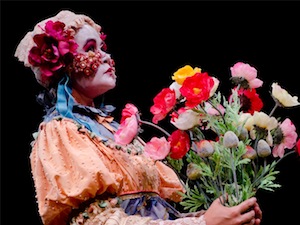
Australian designers Romance Was Born have created wonderful costumes for a show that draws so much inspiration from the days of travelling carnivals. Every inch of the cast seems to sparkle, though I am glad Edward Gant (self-professed “prodigy, soldier, traveller, poet but always and ever a showman”) has such a glorious, glittering cape to distract from a fake potbelly that never quite looks right. The cast of four play numerous roles, from their carnival selves to teddy bears who just want some imaginary tea, whilst clever staging enables a chorus of pimples, bursting with “cheese,” to dance for us. Delicious.

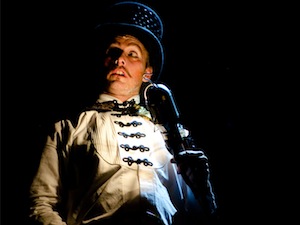
I’ll admit that Paul Bishop is not the kind of Gant I expected, but his voice is perfect and he wears that moustache with finesse. Occasionally, perhaps uncomfortable in the role, he overplays Gant by mere inches and loses the confidence he needs to be ringleader. Bryan Probets* slips most effortlessly into his role as Jack Dearlove (and others), and seems the most versatile and genuine of the cast. Emily Tomlins (recently seen in Julius Caesar) is less convincing—she never quite disappears into her characters—while La Boite newcomer Lindsay Farris is competent, but like Tomlins never quite melds into the setting, unable to lose the Athletic Young Australian Bloke vibe.

Sarah Goodes clearly has a steady hand as director, and Steve Toulmin’s music delivers. With so much working in the play’s favour, the stage certainly was set for a mind-blowing performance. But, as I watched, I couldn’t help but be conscious of the fact that the cast were Actors (with a capital A) only pretending to be carnies. Possibly I go to more circus than is healthy. None the less, this La Boite/Sydney Theatre Company co-production delights, disgusts, enchants and surprises with what must be called amazing feats of theatre.


*I read, in his bio, that Bryan Probets was in the great Aussie vampire flick, Daybreakers. I was certain I remembered him as a vampire scientist working for the baddies. Turns out he was a subsider (a very uncivilised vampire indeed) in full make-up, so there’s no way that I actually remember his face. Memory is so fallible…but “the truth of life lies least of all in the facts,” right? Right?

Edward Gant plays until June 12 at La Boite. You can read my interview with composer and sound designer Steve Toulmin at Rave Magazine. What did you think of the show? Tell me in the comments section below.

Photos by Al Caeiro for La Boite.