Legally Blonde: The Musical

You won’t hear me say this often — but Oh. My. God, you guys! Legally Blonde, the stage musical adaptation of the film of the same name, is as bouncy, bright and shiny as Elle’s blonde locks. In case you missed the 2001 film, Legally Blonde follows Elle Woods — a ditzy, rich Malibu girl in search of a husband — along her journey to discover her own intelligence, drive, and inner beauty.

It may be that we’re coming to expect musical extravagance from anything John Frost (no relation, as far as I know) has a hand in producing. But Legally Blonde goes above and beyond. Its staging, choreography (Jerry Mitchell) and design (David Rockwell) are pretty close to flawless, from Elle’s towering Barbie-pink Delta Nu sorority house onwards. This is as glossy as musical theatre gets.

Mitchell’s choreography, in particular, has a way of drawing the eye towards detail — in costume, body language, or lyric — without losing sight of the bigger picture. Musically, Legally Blonde’s score (Laurence O’Keefe and Nell Benjamin) is no classic. The opening number, “Omigod You Guys”, is an instant earworm and “Chip on My Shoulder” is a resonant study-anthem, but beyond that the songs only really serve to carry us along through the plot. That’s not to say there aren’t lots of laughs — there are. The dialogue (Heather Hach) is sharp and sassy, if not terribly self-aware.

Lucy Durack (WICKED’s Glinda the Good Witch) is an exceptionally strong singer. She plays an endearing Elle more reminiscent of Clueless’s Cher (Alicia Silverstone) than Reese Witherspoon. Along with her shrill-voiced “Greek Chorus” of Deltu Nu sorority girls, her energy and optimism is infectious. When Elle arrives dressed as a Playboy bunny to a stuffy academic do, her confidence in the face of humiliation deserves the cheer it gets.

Rob Mills rose to fame on Australian Idol, and he’s in his element as the smooth, douchey Warner. David Harris channels dorky-but-charming Joss Whedon leads for his Emmett, the TA who encourages Elle to prove Harvard — and Warner — wrong. Helen Dallimore is a real standout as Paulette, a down-on-her-luck manicurist. But let’s not forget little Bruiser — Elle’s Chihuahua pup — who incites choruses of “aww!” from the audience (and never misses a cue or poops on anything!).

Legally Blonde: The Musical

Despite all this, Legally Blonde: The Musical is sparkly, shiny, feminist fool’s gold. (Oh come on, you knew this was coming from me.) Run the Bechdel Test past the play and you come up with one scene in which two women talk about something other than men — despite the major theme of Women Discovering Their Worth Through Study.

[SPOILER WARNING: highlight to read the next paragraph]

From here, it’s easy to follow the progression: Elle enrols at Harvard to pursue Warner; she gets into Harvard not because she passes her LSAT (she does) but because Admissions likes her headshot; she threatens to give up because Warner and friends belittle her; she gets back on the horse after a pep ballad from Emmett; Elle helps Paulette face down her ex — but Emmett supervises; and she gives up again because her professor sexually harasses her. Then, at last, we have the Bechdel-passing scene — followed by Emmett-supervised success and an engagement. (Elle’s endgame proposal feels something like a concession — as if that’s the fight for equality done with.)

[END SPOILER WARNING]

Some might accuse me of nit-picking. Sure, any of those instances in isolation are fine, and there’s nothing wrong with a male mentor. But, viewed overall, Legally Blonde’s final message isn’t “girls can do anything!” It’s really: “girls can do anything — with guidance from a man!”

There are other problematic elements. The scene that gets the biggest laugh is when Elle’s lesbian classmate responds enthusiastically to the “bend and snap”, Elle’s signature attention-grabbing move. It’s a joke that relies on the idea that lesbian desire is inherently funny. I could go on.

We should also mention, while we’re on serious matters, the totally unfortunate-looking shiny potato sack of a suit Elle pours Emmett into as she makes him over. Elle, I thought you had a Bachelor in Fashion Design!

In short: Legally Blonde is exceptionally well staged, wonderfully performed, and fabulous fun. Mad props! Go see it — and enjoy it. But take your critical eyes with you. Elle Woods wouldn’t expect anything less.

Legally Blonde runs at the Lyric Theatre, QPAC, until 21 April 2013.

P.S. Apologies for the late review! I saw Legally Blonde on opening night, 15 March, and then lost my review notebook. But here we are!

Escape from the Breakup Forest

Escape from the Breakup Forest (directed by Claire Christian and Ari Palani) is the Brisbane debut for Toowoomba’s Mixtape Theatre Collective, who formed in 2011. The show’s cut-out-and-colour-in forest set pieces take root in the Judith Wright Centre’s Shopfront.

The Shopfront is a good space for Mixtape’s intimate offering. The border between stage and audience is just a line of masking tape. We share the casual cabaret seating with a fellow critic, whom I hadn’t seen years, and a traveller who bought a ticket on a whim.

Steve Pirie, as Josh, takes the lead in a plot as simple as “boy loves girl; girl leaves boy; boy meets puppet.” The collective take their time telling the story of Josh’s romantic youth and eventual delirious five-year spin with Emma (Ell Sachs) — which ends in three years of red wine, Special K, and Friends re-runs. The real action starts when our mopey protagonist wakes up in a mystical land, the Breakup Forest, and meets Curly (puppeteering by Dan Stewart).

Escape from the Breakup Forest is one part Boy Girl Wall, one part Scott Pilgrim, and one part fresh-but-relatable comedy. In the mystical Breakup Forest, Josh must battle the memories of his exes and others who’ve hurt him. The narrative style (even some sound effects) seems heavily influenced by the work of Brisbane’s Escapists. Regardless, this production — along with the collective’s proactive attitude to making and funding theatre — suggests there’s more to come from Mixtape. And I’ll be watching.

Escape from the Breakup Forest

Pirie is one multitalented chap: he wrote and designed Breakup Forest, as well as performing the central role. Suitably pitiable as Josh, he embodies the role with just the right amount of charisma. Despite lingering on Chapter One, the scriptwriting is sharp. The cast has our motley table of viewers laughing together — and frequently.

The monochromic set design, along with projected animations, brings to mind “Elmo’s World” or, for a more grown-up audience, Don Hertzfeldt’s “Rejected”. Coloured lighting works really well in this regard, but could be harnessed more often. The cast, wearing white tees with details gaff-taped on, use cardboard props as costumes and weapons as they flit between roles. Sachs proves herself to be a versatile actor as she plays a series of Josh’s challengers: the female friend who dotes on him, the “slut” who rejected him in grade nine (a problematic character), and (signal boss fight) the memory of his ex-girlfriend Emma.

Unfortunately Curly’s simplistic design is limiting. Despite Stewart’s best efforts, Curly lacks the individual spirit we’ve come to expect from Muppet-like hand puppets — a pity, as he proves to be a major player in Josh’s story. But perhaps Escape from the Breakup Forest’s fatal flaw is optimism; in the end, the play takes a saccharine and all-too-easy escape route. While it might be a common fantasy, few dumpees as dedicated to red wine and re-runs as Josh can tap together their ruby slippers and vamoose; this particular wood is dark and deep, and there are usually miles yet to tread — on foot.

The Mixtape Collective’s Escape from the Breakup Forest plays at the Judith Wright Centre until 23 March 2013.

Au revoir, Kendra

In 2000, I was 11. We’d just moved back to Brisbane from Cambridge, UK, and I had failed to get my Hogwarts letter. I can’t say Year 6 was great. It was my fifth primary school across three countries. I was a busty nerd with an English accent; I spent a lot of time in the library. I did have a couple of friends. One, whom I doted on, gave me two things to remember her by: a pair of old black sneakers (which I wore, worn and repainted and worn again, until Mum binned them) and a kitten.

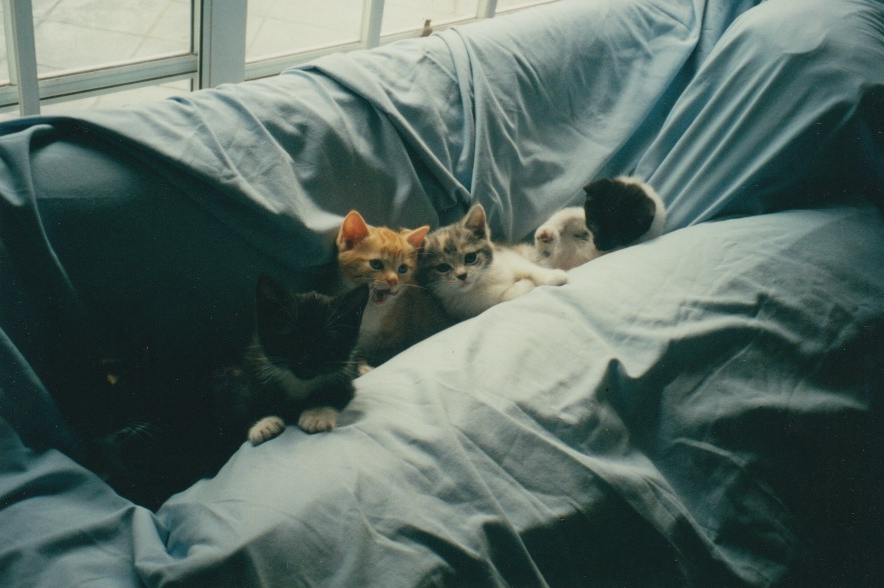
Kendra and siblings — she is in shadow, second left, looking straight at the camera.

Late in 2000 that friend’s moggy found herself in the family way. These are the little dudes that emerged: four boys (I think), and two girls. Mum let me choose one. I met them when they were three weeks old, eyes barely opened. There was a little grey girl with apricot patches and a tinier tortoiseshell. I’m a pretty indecisive person. I deliberated at length. I tried to talk my parents into letting me have both — it seemed cruel, anyway, to separate them. In the end, though, I think I pitied the tortoiseshell runt. I named her after the short-lived slayer-with-the-dreadful-accent who fought alongside Buffy in season two: Kendra.

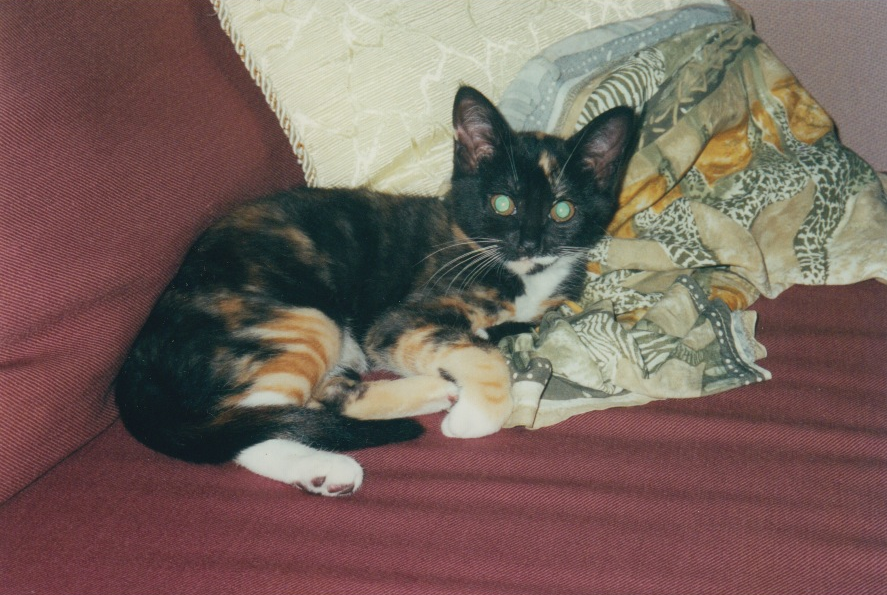
Kendra on the stairsKendra was a difficult kitten. She drove my mother mad by shitting exclusively behind the TV, all over the cords. She climbed the blinds. She licked powerpoints. It seemed she had the deathwish of her namesake. But she had an enormous head on an impossibly-tiny body (see Exhibit B, above); she won us over pretty quickly.

Kendra had a taste for adventure early in life, but time made her a homebody. We had to chickenwire the fences in her first year to prevent her running out onto the busy road in Hamilton. I remember her darting up the jacaranda out the front, only to come face to face with a pair of crows, who just laughed at her. I had to pry her claws off the bark; she had just frozen there.

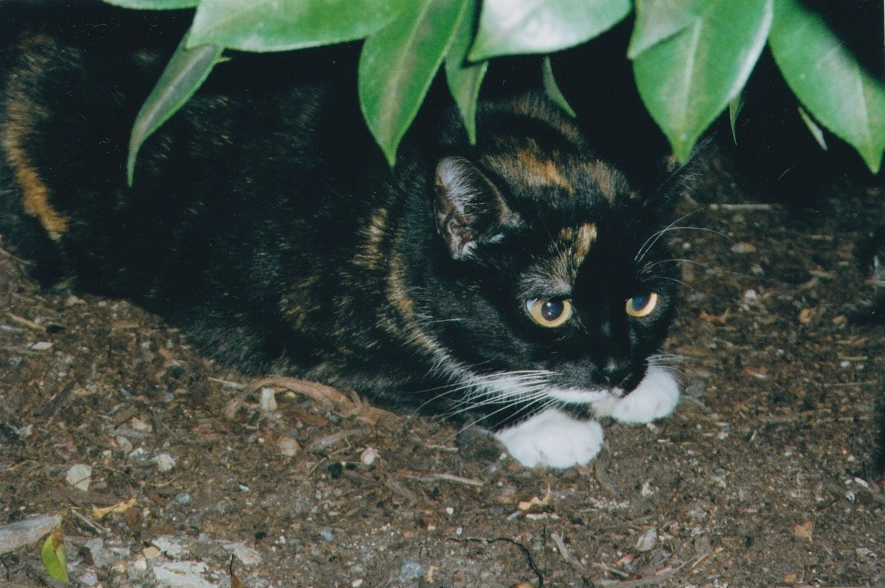
Kendra as a teenWhen I was 13 and Kendra was two — the first year of high school — we moved into a house my parents designed and built in the true suburbs. (It features a park built on the grounds of a demolished abattoir/tannery. Lovely!) My parents have a wonderful and beloved native garden. Kendra’s favourite spots were under the frangipani, on a warm paver hidden in the palms out the front, and close — but not too close — to the pool. Inside, she preferred the diamond-shaped motif at the centre of the foyer tiles, her old pink chair, and wherever Mum is.

Kendra 05

Around 2008, Kendra struck up a rare friendship with a very handsome Cornish rex from across the road. (He was intelligent enough to answer my question — “Where do you come from?!” — and lead me to his front door.) His name was Romeo. (I’m serious. It suited him, too.) He was charming enough that my parents didn’t mind him dropping by, strolling right into the house, to hang out. (It’s unfortunate I can’t find his photos — he looked like Hipster Simba.) He was an adventurous tom; it wasn’t long before we heard he’d met a car on the adjoining road.

I remember taking a couple of photos of Romeo with Kendra around to his family. Grandma and about four young children answered the door; Grandma eyed shaved-headed me with suspicion and gave me a talking down for mentioning that the cat had died in front of the children. “He has gone on holiday.” She handed the photos to the youngest of the children, who wandered outside and dropped them in a puddle. They shut the door in my face.

The remainder of the neighbourhood’s tomcats were less friendly. Kendra stopped going outside, except for essential garden visits, a while after that.

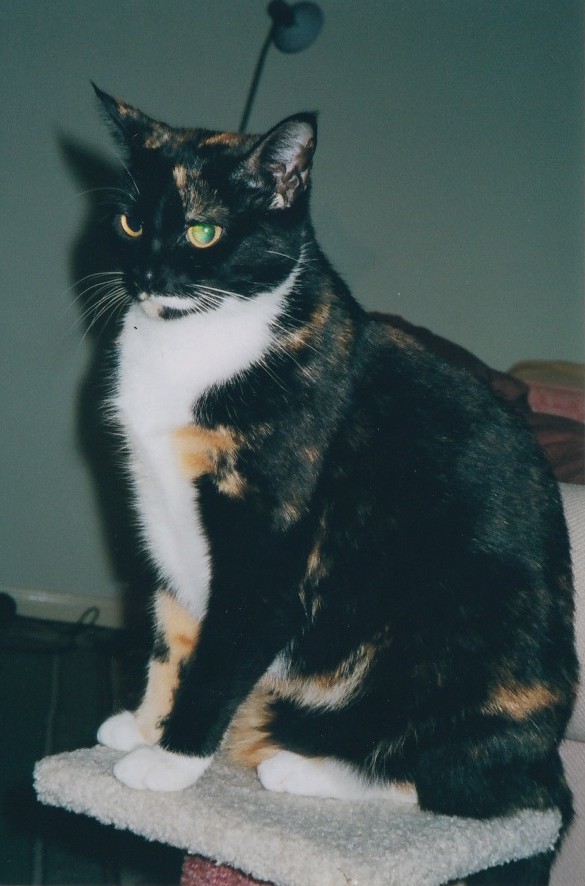
Kendra 03Kendra seemed determined to get past her runty beginnings. No matter how strict the diet, Kendra continued in her quest to become the roly-poliest of cats. Belly-rubs were pretty much currency in the Kendra Frost household. I wish I could find the photo of her sitting at the set dining table, evidently awaiting dinner with the rest of us [edit: found it!]. Her favourite foods were: anything. She even ate vegetables on occasion.

Kendra was extremely affectionate. She was the apple of Dad’s eye and seemed to have a knack for knowing when Mum was unwell. Given her bad knees and kidney and stomach troubles, she was a good contender for best tempered in a family of chronic pains. (Though we did have to whip out the Kitty Valium to get her into the bath.) She won over (most of) my partners as the years wore on. She was pretty good at giving (or denying) the tick of approval. If she liked you, she’d snuggle in behind your knees when you slept.

Kendra ready for dinner

I saw her three days before she died, and she was very happy to see me. I scooped her up and carted her around the house for a longer-than-usual while. She had a sort of pleasant vastness. (She made a great pillow.) We had started to worry she might be running out of time — she’d been making a lot of trips to the vet — but it was an abstract idea. Who knows what “soon” means?

My parents found Kendra on the tiles close to their bedroom door. She died during the three hours they were at Cloud Atlas. Mum was bewildered — just that day she had washed all of the kitty blankets at once. They buried her with one of them — one of my baby blankets — in the patch of garden where I’d planted sporadically successful rosebushes years before. I’d had an overwhelmingly good day; my parents decided to wait until the next day to tell me. Kendra and I had been friends for 13 years. I guess I would’ve liked to have seen the body. But I appreciated my parents’ gesture, and it couldn’t be helped.

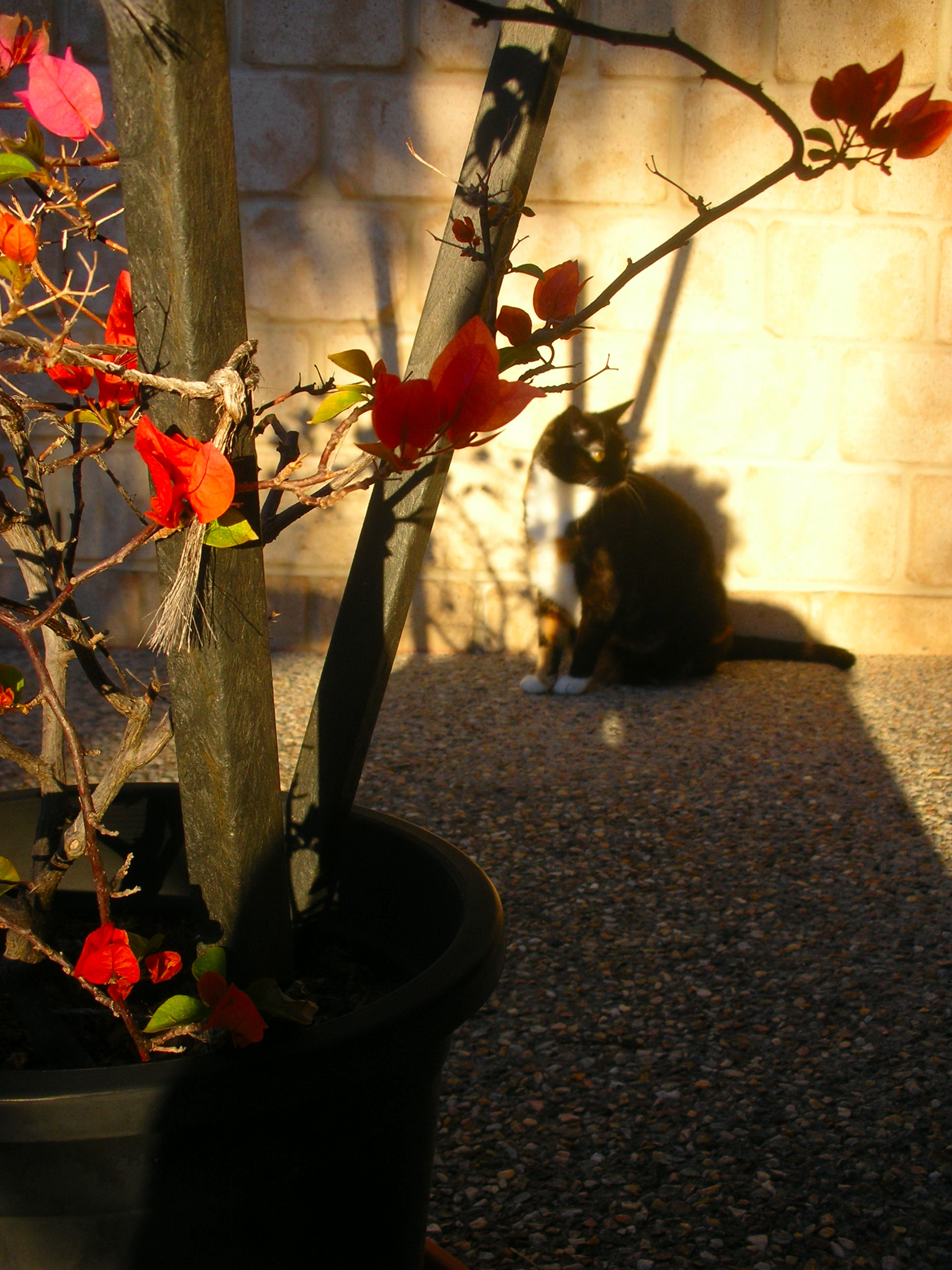
zf_ kendrawbouganvil

This weekend we planted daffodil bulbs over Kendra’s grave. I spend a fair amount of time in cemeteries, but I don’t typically know anyone in them. Even as an adult it’s hard to get your head around the idea that your friend is under the ground.

Now, I know you few readers are good folks who understand it’s only a token gesture to give a measly 1000 words to a cat you spent half your life-to-date with. (I once had a boss belittle me repeatedly for grieving the death of a pet rat.) But it’s funny — we humans, or most of us, spend our lives trying to do stuff that might make our lives memorable. Domesticated or not, animals don’t have that goal and most don’t get that chance. Kendra wasn’t the first cat in space and nothing about her was meme-able. She doesn’t have a tombstone. She wasn’t even registered with the council. But my parents’ house seems horribly empty now. And we love her a lot. So here we are.

Kendra Frost
1 Sept. 2000 – 11 Mar. 2013
Died at Brisbane

Whispers: At Sea

Stories speak to us; they whisper, cajole, and, on occasion, shout out to be heard. Join British Fantasy Award winner, Angela Slatter (The Girl with No Hands, Sourdough & Other Stories, Midnight and Moonshine), alongside special guests novelist, Jessica White (Entitlement, A Curious Intimacy), poet Zenobia Frost, and short fiction writers, Samuel Maguire and James Butler, as they share their stories at sea.

When: Saturday 9 March 2013, 3pm
Where: State Library Cafe, SLQ

Holding the Man

La Boite, February 26

I first saw Tommy Murphy’s adaptation of Timothy Conigrave’s memoirs half a decade ago. It was a devastating experience then, at Brisbane Powerhouse in 2008. Thus it is that I have no excuse for my rookie mistake at La Boite: I have forgotten tissues. David Berthold returns to direct the story of Conigrave, a Melbourne actor and playwright born in 1959 whose high school love affair would last a lifetime — albeit a tragically short one.

There are two distinct halves to Holding the Man: the youthful comedy of act one, and then the slower march of act two. To say it’s a play about AIDS would be to sell Conigrave’s work and life short; rather, it’s about life: growing up gay in Australia in the 1970s and 80s, being in love, making mistakes, and negotiating family, politics and health.

The frank dialogue sets the pace for act one. Murphy’s script is refreshingly open about sex — enough to cause a few jaw-drops in the audience. We share the stalls with a class of Year 11 drama students in uniform — from my personal experience at a religious high school, this must sure beat any sex education they’ve had to date.

Alec Snow is the right man for the job as Tim; we are immediately on his side as he casually woos the gentle athlete, John Caleo (Jerome Meyer). Murphy has translated their voices authentically to the stage; their sincerity is the quality the play pivots around.

Holding Man

As we dash through the decades, we meet a kaleidoscope of queer archetypes played by a strong supporting cast: Eugene Gilfedder, Helen Howard, Jai Higgs and Lauren Jackson. The cast are made vulnerable by on-set costume changes in amongst mirrors bedecked with stage lights. It’s a good choice — in Holding the Man, everything is exposed.

Throughout this, Tim and John’s relationship develops and wavers. Then the 1980s bring their horrific revelations. Act two slows its pace: while the epidemic rages, each tragedy is deeply personal. The strongest scenes play out as fevered amalgams of drama workshops and medical scenarios — these whirlwinds make our hearts thump with the protagonist’s confusion and fear.

At times, the ensemble seems a little uncomfortable with the staging. But then, Holding the Man isn’t really a play in the round, and this is the Roundhouse Theatre. Still, the discrete elements of Brian Thomson’s design are striking and effective, and Micka Agosta’s uncanny puppetry makes the play’s final scenes resonate. If 2008 is anything to go by, those chills may resonate for years.

It’s easy to look back on the 70s and 80s and think about how much Australia has changed for queer people, their friends and families. But the poster for Holding the Man (pictured) has Snow and Meyer in a pose evocative of Queensland Association for Healthy Communities’ now-famous “Rip & Roll” campaign of 2011. Last year Queensland Health defunded QAHC, which provided HIV prevention services to local LGBTIQ communities. It’s a pertinent time to revisit Conigrave’s story, and to ensure that it does resonate.

Holding the Man runs at La Boite until March 16.

Dear Stilts

On Sunday night, a friend prodded me with a link. “Have you seen this? You have fanmail.” I thought it best to reply to Aimee Lindorff in kind.

Dear Aimee,

I’m glad you made it to Riverbend, despite the rain. My reasons are selfish: I really needed your letter this week.

When the page first loaded on my phone and I could see my name at the top, it was a strange thing indeed. What was I in for? My first thought was that I was, in the abstract sense, In Trouble. Perhaps it’s a full name thing. (I don’t have a string of middle names for a parent to invoke.)

At the time your letter arrived, I was making pizza with my boyfriend. We stopped to read and I absent-mindedly worried a hole in the wrong end of the packet of pizza bases. Maybe I shouldn’t make a big deal out of it. But it’s not every day someone I don’t know writes me a review-letter and publishes it in a literary journal (read: never), so blast it. I’ll make a big deal.

Earlier this week I sat down with my manuscript with the aim of making revisions before sending it to the next publisher. I may have had a tiny tantrum. Pages may have found their way, haphazardly, all over the room. There were plenty of factors at work leading to this little game of 72-poem pick-up, sure, but above all it was one of those moments where this whole art thing seemed pretty pointless.

I’m not saying that writing is really a lofty spiritual calling — it isn’t — but damn it was good, great, brilliant to hear that my poems had brought someone such pleasure. Even better, it was a privilege to read your eloquent reaction and your memories of Toowong and its cemetery. Every time I reread the address, it’s a warm, fuzzy shock.

I am going to print it out and stick it near my desk. Possibly also on the fridge. Thank you.

Zenobia

P.S. I am glad you liked my cat-lady dress.

Overland Emerging Poets

Peter Minter over at Overland has kindly included me in their Emerging Poets Series. There’s a photo by Raw Bones Photography, a flood poem, and a little interview.

Bettina Wild and I have gotten to work on our collaborative graveyard project. We might even give you sneak-peeks along the way. Bettina has just moved to Kent, in England; I’m enjoying collaboration-by-correspondence. I think what we come out with, in the end, will be striking. Expect new poems, presented in new ways, illuminated by Bettina’s inky genius.

February Poetuary Mortuary Events…

I have two spectacular (and very different) events to kick off the year (since January was something of a write-off for many of us)…

Lady Marlene presents My Vicious Valentine

Shake off the sugar of the the Saint’s day itself with some vicious, vermicious Valentine’s venom at in West End on Feb 17. I’ll be performing some vile love poems — and even, perhaps, brandishing my singing voice — with the Ragtag Band and Lady Marlene’s bevy of burlesque belles. Consider it my cabaret debut. Bookings are essential — dine in or nab a seat at the bar. The Loft, Feb 17, 6.30pm.

Riverbend Poetry Series 1

On the deck at my favourite Brisbane bookshop, I’m very fortunate to be able to read alongside Anthony Lawrence and Vanessa Page. Julie Beveridge, Carmen Leigh Keates, Chris Lynch and Cindy Keong will also launch their Choose Your Own Poetry Adventure amplified e-book. I’ll be previewing poems from the manuscript I completed recently at Varuna, in the Blue Mountains. Bookings are essential. Riverbend Books, Feb. 19.

Seeya, 2012

It has been a mixed year, but somehow we packed a lot into it. Like a small bottle overfilled with the makings of gingerbeer; if we shake it up too much tonight, the whole year might burst out and overflow into 2011 and ’13. (2011 deserves everything it gets, but I’d like 2013 to have a shot at a fresh start, thank you.)

In 2012, I’ve travelled more than ever: overseas once, and interstate three times (to Vic., NSW, and SA) and all around Queensland with the QPF Regional Roadshow. At Varuna, in November, I finished an 80-page poetry manuscript (I hope you’ll see it soon) and sent dozens of new and edited poems Continue reading