Anywhere Fest: Gumpoldskirchen

For our second Anywhere Festival Q&A, stellar playwright Bianca Butler gives us the low down on Gumpoldskirchen.

Q. Describe your show/s in under 25 words.
A. Estranged brothers take a rail journey across Europe to collect their father’s ashes. Catching up is funny, painful and more than a little claustrophobic.

Q. What makes your Anywhere venue the perfect fit?
A. Milton ‘Railway’ Park is situated between the Milton and Auchenflower train stations, and even has a kids’ playground in the shape of a steam engine, so the transit theme is strong. This ties in perfectly with Gumpoldskirchen, which is all about journeys, both literal and relational. The majority of the action takes place in train carriages and train stations, and throughout the whole play we see the transitory relationship of the protagonists, who struggle to find common ground. In their journey to become better brothers, they also move toward closure in their troubled relationship with their father. I’m indebted to the clever folks at Underground Productions for sourcing such a unique and thematically appropriate setting.

Gumpoldskirchen — Bianca Butler

Q. If you could stage your play anywhere in time and space (after Milton, of course), where would you choose?
A. It probably sounds boring, but I’m really happy with my play being performed here and now. If I could look a year or two into the future, I would love to see it transfer to main house production with one of Brisbane’s professional theatre companies, like La Boite. I think the play would work really well in the Roundhouse Theatre space. Longer term, I would love to take a touring production to all the towns and cities that feature in the play, starting with the tiny village of Clun, Shropshire, and finishing up in Gumpoldskirchen itself.

Q. Family secrets are exposed in Gumpoldskirchen. Do you have any ancestral skeletons in the closet you could tell us about?
A. That’s a tough question. The play I’m working on now is inspired by something that happened in my dad’s family when he was a boy, but there aren’t really any skeletons there. It’s about how his parents took in American soldiers on R&R leave from the Vietnam War. It’s not very scandalous, but I found the research process fascinating.


Q. Will Poirot be accompanying us on this potentially dangerous train journey?
A. Alas, not including Poirot was my folly! There are a couple of Belgian characters, but sadly they are neither detectives nor cultivators of a handsome moustache. Next time perhaps.

GUMPOLDSKIRCHEN runs at Milton ‘Railway’ Park, Corner Nerida Lane & Milton Road, from 8 to 12 May, 2013.

Food: Item Not as Described

Trigger warning: discussion of sexual violence. (Also, relevant to that trigger warning: spoiler warning.)

La Boite describes Food as a “feast for the senses with an erotic mix of words and movement.” Critics call Steve Rodgers’ new play (directed by Rodgers and Kate Champion) sensual, a hilarious rom-com, soul food — “It will make you happy” (Stage Milk). Reading these reviews, I began to wonder if I’d seen a different play.

In Food, two sisters run a backwater takeaway joint inherited from their mother. Elma (Kate Box), the responsible elder sibling, is resigned to the daily heating up of Chiko Rolls until laidback Nancy (Emma Jackson) convinces her to transform the family shop into a restaurant. They hire charming Turkish traveller, Hakan (Fayssal Bazzi), to help out. From here, it’s well-trodden territory: the restaurant becomes a roaring success and Hakan spices up their lives as well as their cooking.

Anna Tregloan’s design is fantastic; the set features one central table against a backdrop of pots and pans. Clever projections transform these into glowing moons that frame home movies — the sisters’ childhood memories.

All action — highs and lows — takes place in this kitchen, and most of it whilst chopping vegetables. Needless to say, food is very important to Food. But it’s a stilted kind of food preparation, always pausing for conversation. I find myself wondering how the Chiko Rolls ever make it to the fryer. It makes me nervous. Handing out soup and wine to the audience is a nice touch, but being fed during shows is becoming more commonplace in the trend towards immersive theatre, and that puts the onus on each meal to do more. Mugs of minestrone abandoned after the show suggest that this scene is more of a distraction than a treat.

Box and Jackson

For Food, Rodgers collaborates with dance theatre company Force Majeure — something I was surprised to be reminded of after the show. The emphasis on movement is subtle or, at least, less rhythmic than it is frenetic.

Nothing lacks in the casting. Box, in particular, gives a genuine performance as the stoic Elma. It is uplifting to watch Elma realise her potential, and value, as a restaurateur. Jackson plays an intriguing Nancy, while Bazzi as Hakan makes an interesting transformation from happy-go-lucky pixie dream boy to entitled Casanova.

The trouble is that Food isn’t sure what kind of play it wants to be. It opens with Nancy dancing; increasingly, her movements become distressed, controlled — she is raped by an invisible presence. Cut scene, and we meet Elma and Nancy in the kitchen — where most of the play takes place. The sisters bypass the fourth wall now and then to narrate recollections in, variously, in the first and third person. Thus we flit back and forth between horrifying memoir (including several other instances of sexual assault) and cheery kitchen repartee.

When Hakan enters, pulling focus with a dramatic monologue and slideshow of his former lovers, the tone changes again — so much so that this scene is almost a play within the play. In some ways, this makes sense (he is the catalyst that’s meant to change the sisters’ world) but no transition is smooth. Likewise, while the women’s third-person monologues dissociate them from their pasts, they also promote Food’s overarching stylistic inconsistency.

It’s little wonder Elma and Nancy would want to distance themselves from the childhood memories they recount to us (in vivid detail), which include an instance of gang rape. But these sexual assaults, a source of tension between the older and younger sister, are never truly addressed — they serve to explain Nancy’s promiscuousness and sudden disappearance years before, and likewise to explain (in part, at least), Elma’s struggle with eating disorders. They’re scenes played to disturb the audience and garner sympathy, but these revelations don’t change the story or heal the characters.

The character of Hakan fulfils the cliché of the exotic traveller, just passing through, bringing with him a ray of sunshine. But this kitchen hand claims he can’t help but ogle a beautiful woman. (Elma points out he looks at Nancy “like she’s a steak.”) In the workplace, he sneaks up behind Nancy to embrace her. One failed seduction later, and he sets about taming the shrew instead.

So where is the burning sense of the erotic in Food that everyone’s talking about? It can’t be the slow top-and-tailing of beans, nor the minestrone, nor the Chiko Rolls. It’s certainly not the gang rape of a teenager by her peers while her sister waits outside. So it must be the creeping Casanova, overwhelmed by passion, who just can’t help himself. Given the women’s backstory, that this predatory sexual entitlement goes unchecked is problematic — unnerving, rather than erotic.

Rodgers’ script is thoroughly Australian in its sense of humour, yes. Moments of wit and playfulness shine through family drama and heartbreaking disclosures. But is it actually a comedy? I’d wager it belongs firmly on the drama shelf, far away from foodie feel-goods and tragi-comic comedies. But ultimately, it’s a shallow drama — with no one but the restaurant really changed by the end. Uplifting? I’m confused.

As a final note, as you enter the Roundhouse there’s a sign warning that the play contains course language, adult themes and simulated sexual intercourse. That’s a very different matter from themes of sexual violence, mentioned nowhere on that sign or on the website blurb — but appearing repeatedly in the play. I know it’s not just me who takes these themes into account when choosing what to see. On their booking page, La Boite takes the time to advise that “not all audience members will receive food.” Yet a warning regarding explicit sexual violence is overlooked.

Rodgers relies on “women’s issues” like sexual violence, eating disorders and fraught mother-daughter relationships to introduce pathos to a play that never intends to develop its three leads, who perform admirably in the face of a shallow script.

“It’s really about wanting,” says Rodgers in an interview with the Sydney Morning Herald. “Wanting intimacy with people, wanting the love and sex that feeds you and that can complete you, settle you.” Food tries to explore the desire for intimacy in the face of sexual trauma, but to do so Rodgers and Champion needed to handle Nancy and Elma’s childhoods with the depth, subtlety and sensitivity they deserved. That way, their moments of joy would have been all the more uplifting for the contrast. Alas, I certainly found Food wanting.

Food runs at La Boite until 27 April 2013.

Holding the Man

La Boite, February 26

I first saw Tommy Murphy’s adaptation of Timothy Conigrave’s memoirs half a decade ago. It was a devastating experience then, at Brisbane Powerhouse in 2008. Thus it is that I have no excuse for my rookie mistake at La Boite: I have forgotten tissues. David Berthold returns to direct the story of Conigrave, a Melbourne actor and playwright born in 1959 whose high school love affair would last a lifetime — albeit a tragically short one.

There are two distinct halves to Holding the Man: the youthful comedy of act one, and then the slower march of act two. To say it’s a play about AIDS would be to sell Conigrave’s work and life short; rather, it’s about life: growing up gay in Australia in the 1970s and 80s, being in love, making mistakes, and negotiating family, politics and health.

The frank dialogue sets the pace for act one. Murphy’s script is refreshingly open about sex — enough to cause a few jaw-drops in the audience. We share the stalls with a class of Year 11 drama students in uniform — from my personal experience at a religious high school, this must sure beat any sex education they’ve had to date.

Alec Snow is the right man for the job as Tim; we are immediately on his side as he casually woos the gentle athlete, John Caleo (Jerome Meyer). Murphy has translated their voices authentically to the stage; their sincerity is the quality the play pivots around.

Holding Man

As we dash through the decades, we meet a kaleidoscope of queer archetypes played by a strong supporting cast: Eugene Gilfedder, Helen Howard, Jai Higgs and Lauren Jackson. The cast are made vulnerable by on-set costume changes in amongst mirrors bedecked with stage lights. It’s a good choice — in Holding the Man, everything is exposed.

Throughout this, Tim and John’s relationship develops and wavers. Then the 1980s bring their horrific revelations. Act two slows its pace: while the epidemic rages, each tragedy is deeply personal. The strongest scenes play out as fevered amalgams of drama workshops and medical scenarios — these whirlwinds make our hearts thump with the protagonist’s confusion and fear.

At times, the ensemble seems a little uncomfortable with the staging. But then, Holding the Man isn’t really a play in the round, and this is the Roundhouse Theatre. Still, the discrete elements of Brian Thomson’s design are striking and effective, and Micka Agosta’s uncanny puppetry makes the play’s final scenes resonate. If 2008 is anything to go by, those chills may resonate for years.

It’s easy to look back on the 70s and 80s and think about how much Australia has changed for queer people, their friends and families. But the poster for Holding the Man (pictured) has Snow and Meyer in a pose evocative of Queensland Association for Healthy Communities’ now-famous “Rip & Roll” campaign of 2011. Last year Queensland Health defunded QAHC, which provided HIV prevention services to local LGBTIQ communities. It’s a pertinent time to revisit Conigrave’s story, and to ensure that it does resonate.

Holding the Man runs at La Boite until March 16.

Can’t Be Artsed #5: All The Things

This week, while I should have been attending to The To-Do List, I instead attended a diverse bunch of artsy gigs. It was pretty rad. I should be studying/working/poeting/editing, but I wanted to at least jot down some thoughts before I lose ’em.

Henry Rollins, May 3

I’d never heard of Mr Rollins, nor his career with punk band Black Flag, before friends gifted me a ticket for my birthday. I decided to head in blind and find out what this spoken-word maestro has to offer on the fly.

Continue reading

Can’t Be Artsed: Mini-Reviews #1

Welcome to the first edition of my Can’t Be Artsed mini-reviews of All the Things. Here’s this week’s motley offering: The Dresden Dolls, James and the Giant Peach, and Sherlock Holmes — A Game of Shadows.

Music: The Dresden Dolls (The Tivoli, Jan 5)

I’ve had the pleasure of seeing Amanda Palmer live three times in Brisbane, but though I’ve listened to their albums for years I’d never before seen The Dresden Dolls (Palmer with drummer Brian Viglione) do their thing together. Holy fuck, it was an intense and glorious evening.

Tom Dickens’ (The Jane Austen Argument) lovely vocals opened the show. A brief Briefs interlude was delightful, as expected — Davey Gravy shticks his shtick so well, and Captain Kidd’s sparkly cocktopus is a joy to behold (and he’s an incredible hoopist). I was thrilled to see The Bedroom Philosopher again — though he gigs in Brisbane semi-regularly, fate often thwarts my attendance. Acronymphomaniac, with the lyrics, “I eat SNAGs for breakfast,” is especially rad.

Palmer and Viglione’s dynamic is so natural you feel they might wordlessly improvise, like two dancers — both leading, never stepping on toes. It’s enthralling. So is Brian, both as a highly talented percussionist and a man with no shirt on.

With a half-hour encore, I was pretty sore by the end of the gig — and fairly deaf, but I now grok what Dresden Dolls fans have been extolling for years: this duo is a powerhouse.

Let’s start the year positively; five semicolons for The Dresden Dolls. ; ; ; ; ;

Theatre: James and the Giant Peach

Aimed at the 4–8 set, I figured I was still of a reasonable height to see this Harvest Rain adaptation of the Roald Dahl adventure that begins with the protagonist’s parents being gobbled up by a rhinoceros in London and ends in a giant peach in New York. I also took my dad — and we wound up having a fun time, even joining in on the pantomime-style audience interaction.

Josh McIntosh’s costumes are gorgeous (especially Aunt Sponge and Spiker’s frocks) and the homely peach itself is pretty cool. Tim O’Connor (Jesus Christ Superstar) directs this production, and it touched even us oldies. Still, the music was a letdown: tinned orchestration and cheery but forgettable tunes. Variable microphone efficacy didn’t help.

When I spoke to Jack Kelly (playing an earnest young James) for Rave Magazine, he said poor old Earthworm (Belinda Heit) was his favourite character. I have to agree: the blind, legless sadsack has an Eeyore charm. I also liked Dash Kruck’s cockney centipede who goes on to work in a sock factory.

It was quite novel to see a one-hour play at QPAC. I was swept away until the end — and would’ve liked some more, but — alas — it was bedtime for James.

I give it three and a half semicolons.

; ; ; :

James circumnavigates the world in his peach until Jan 21. Call 136 246 or book at http://www.qpac.com.au

Film: Sherlock Holmes II—A Game of Shadows

This pseudo-Sherlock adventure launches guns-a-blazin’ and doesn’t let up until curtains, just over two hours later.

Robert Downey Jr is amusing as a slightly psychic ninja Bernard Black. He doesn’t deduce things so much as know them — we learn this through lots of flashing from Significant Foreshadowing Thing to the next. He demonstrates how clever he is by quoting Schubert. We know Moriaty (Jared Harris) is just as clever because he can quote Schubert back and then make witty comments about trout. More importantly, they can both narrate their own actions whilst boxing. Stephen Fry as Mycroft Holmes is great because Stephen Fry is great; for part of the film he is naked. Good. Jude Law sports a Village People moustache..

There are some gypsies in the movie. You can tell because they’re dirty and they steal things from their friends and they eat hedgehog. Are the Romani the last bastion of acceptable racism in cinema? Noomi Rapace, very far from her role as Lisbeth in that-film-with-a-lot-of-sexual-assault-in-it, plays a dim gypsy in a cute hat looking for her brother or something.

But it is fun (spot the amusing anachronisms), and there is air conditioning. (Today was hot enough to kill — seriously, my panda cories fried in their tank.)

Two semicolons. ; ;

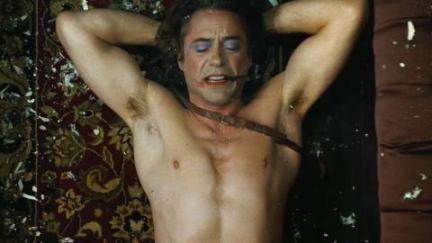
Please let me know what you think of Can’t Be Artsed or suggest Things (any things at all!) I might like to review. I hope you enjoyed this photo of Robert Downey Jr as a half-naked, half-in-drag Sherlock smoking on the floor in a train during a gunfight.